An urgent call to study the cumulative public health impact of ableism on blind people.
By Laura Millar, MPH, MA
Disorders of despair. I heard those words at a recent training with the Robert Wood Johnson Foundation about public health needs and funding, and I have not stopped thinking about them.
In that needs-assessment discussion, disorders of despair were presented as an urgent public health priority. I was startled by the shift. For much of my career, the familiar headlines were heart disease, diabetes, cancer, and the other chronic conditions we worked so hard to prevent. Those diseases have not gone away. But the discussion was moving further upstream: toward loneliness, social isolation, disconnection, and the conditions that can push people toward serious psychological distress, substance-related harm, and suicide.
For me, this was alarming news, but it was also a moment of recognition. Public health is finally talking about the conditions that wear people down. Blind people have been describing some of those conditions for decades.
The Robert Wood Johnson Foundation’s published work on social isolation makes clear that loneliness and disconnection are not simply private feelings. They are associated with physical and mental health risks, including cardiovascular disease, depression, and deaths of despair. The point is not to pit despair against chronic illness. It is to understand the upstream conditions that shape both.
Let me walk you through an ordinary day
A blind person gets a notice that their medical test results are available. The patient portal has unlabeled buttons. Their screen reader says, “Button. Button. Button.” Nothing tells them which one opens the results.
They call the office. They wait on hold. Someone suggests that a sighted friend read the results. Then another inaccessible system complicates scheduling the next appointment. Transportation takes another call. When they finally arrive, the receptionist addresses the sighted person beside them instead of the patient.
Perhaps the person who designed the portal sees a technical oversight. The receptionist sees an awkward moment. The office sees a patient who needed extra help. Only the blind person experiences the entire chain.
Every barrier requires another decision: Do I correct this person? Explain my blindness? Disclose private information? Spend another hour seeking access? Give up this time?
The next morning, it begins again.
Death by a thousand paper cuts
We call many of these encounters microaggressions. But micro does not mean the impact is small. One incident may last seconds. The consequences can stretch across a day, a month, a year, or a lifetime.
An inaccessible form may delay care. A denied ride may cost someone work or connection with friends. An assumption about competence may close a professional door. Repeated dismissals may make a person less willing to seek help from the next institution. The burdens are not just inconvenience. They are time, money, privacy, trust, opportunity, energy, and belonging.
I am a blind public health professional. I understand that blindness is not the same as ableism. I know the difference between asking for help because I choose interdependence and being forced to ask for help because a system has denied me independent access.
Blindness does not make us inherently isolated. Barriers can isolate us. That distinction is a public health question.
Here is the research we need, and the research we do not yet have
A study published in 2025 surveyed 995 adults with disabilities and found that greater exposure to ableist microaggressions was associated with higher depression, anxiety, and stress symptoms. That is important evidence about disability broadly. It is not a blindness-specific finding. The published results do not establish how repeated ableism affects blind people as a distinct population.
Separately, research using a large national health survey found higher levels of psychological distress among adults reporting vision impairment. But those data do not tell us how much distress is associated with blindness itself, how much with discrimination and inaccessible systems, or how those exposures interact.
We have research on microaggressions. We have research on vision and psychological distress. What we have not adequately established is the connection between the two for blind people. We need to study the cumulative impact of blindness-specific microaggressions and inaccessible environments, not merely include a few blind respondents inside a broad disability category and assume the average tells our story.
And we need to do this without flattening the lives of people who are blind and also experience racism, poverty, sexism, homophobia, transphobia, chronic illness, or other forms of exclusion. These pressures intersect; they do not arrive one at a time. A 2024 review of vision-impairment research found limited explicit use of intersectionality. Our research must hear those intersections, not erase them.
This is bigger than blindness
The crisis of isolation and disconnection is not ours alone. People across the country are living with economic insecurity, discrimination, violence, grief, fractured communities, and barriers to care. Despair is not the property of any one population.
But the blind community offers public health a concrete, underexamined example of how preventable barriers can accumulate. I do not want another study asking whether being blind makes people unhappy. I want research asking what happens when a blind person is blocked, doubted, rerouted, spoken over, or denied accessible information again and again, and what changes when those barriers are removed.
That is how we move upstream. We stop treating the individual’s distress as the entire problem and investigate the systems contributing to it.
A call to public health leaders and funders
I am asking the Department of Health and Human Services, federal research agencies, the Robert Wood Johnson Foundation, universities, and public health funders to invest in research designed with and for blind people. Follow these experiences over time. Measure cumulative ableism, inaccessible systems, stress, isolation, missed care, connection, and wellbeing. Examine how the effects differ across intersecting identities. Fund blind researchers and community partners to lead the questions, methods, interpretation, and solutions.
This is consistent with the Foundation’s stated commitment to community-driven health research: research should reflect people’s actual experiences, recognize community expertise, and address structural barriers. It is time to apply that standard to blindness.
And please measure more than harm. Measure belonging, independence when wanted, meaningful interdependence, access to work and community, blind pride, and the protective power of blind-led networks. If we only count despair, we will miss the conditions that help people thrive.
One paper cut may be dismissed. A thousand paper cuts are a public health problem. If we are serious about preventing disorders of despair, we must start studying the cumulative impact of ableism, especially where the data have left blind people invisible.
I love public health. I have spent more than twenty years in this field. That is why I am frustrated, and why I am asking more of it.
Do not ask blind people to adapt to another thousand cuts. Study what is cutting us. Fund the work to stop it.
About the author
Laura Millar, MPH, MA, is a blind public health professional, sociologist, sexual health educator, consultant, and community organizer. She was named a 2025 Carrie Buck Distinguished Fellow at Brandeis University. Her work spans public health, disability justice, research, education, and advocacy. She is the co-founder of the Blind Sexuality Access Network and serves on the board of the National Federation of the Blind of California.
Bring this work to your organization
Laura works with public health agencies, healthcare systems, educators, researchers, and community organizations to examine ableism and build accessible, community-led practice. For research collaborations, consulting, training, or speaking, contact Laura Millar.
Related reading
Read Blindness Is Not the Public Health Crisis. Ableism Is. for a companion public health and civil rights argument.
Get new essays by email
Subscribe for writing on ableism, accessibility, public health, and disability justice.
AI disclosure
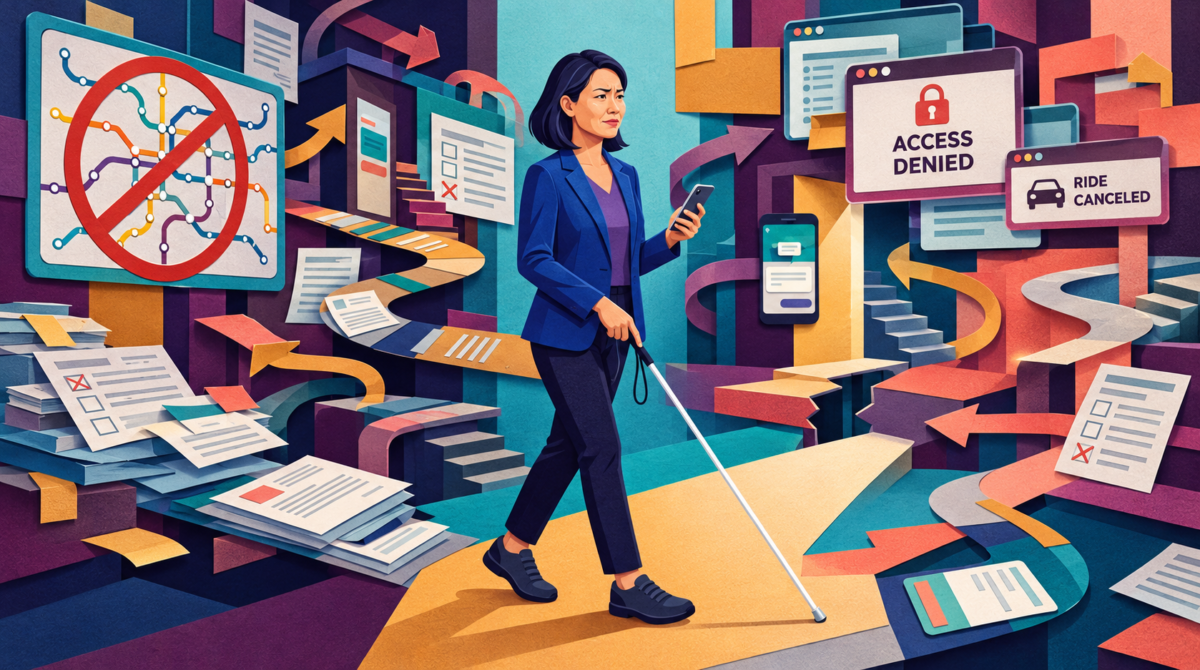
AI assisted with editing and formatting this essay and creating the featured illustration. The perspective, experiences, argument, and editorial direction are my own.