Health Services and Accessibility
Help people understand their options, participate in decisions, and receive support that respects their autonomy.
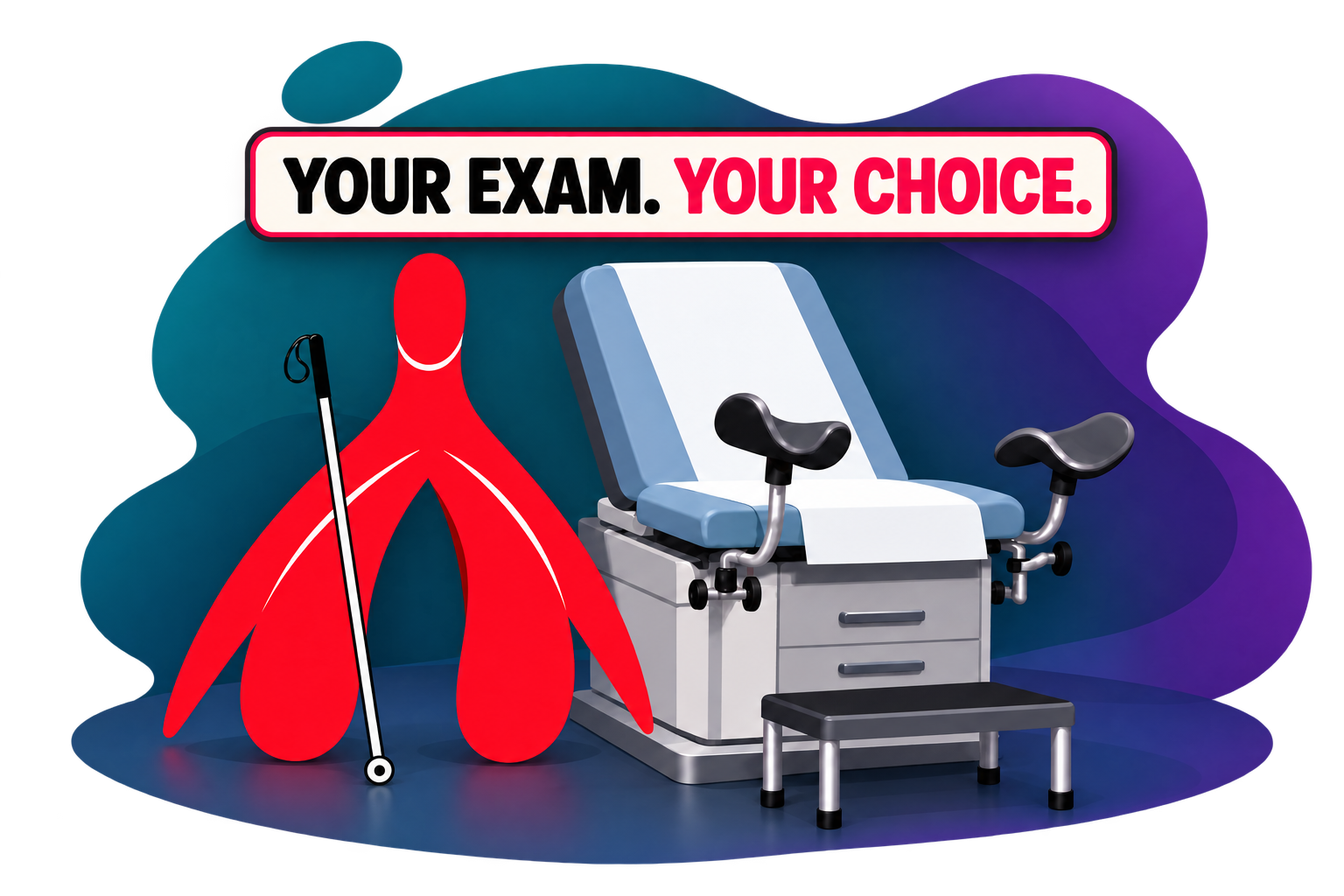
An unreadable form. A conversation directed to a companion. An offer of help that becomes a decision made for someone. These everyday moments shape access, and we can change them.
Hire me for: Provider training, service experience reviews, accessible educational materials, and consultation on consent and autonomy.
Access involves the full experience of receiving services: making an appointment, understanding information, communicating needs, giving consent, and following up.
My public health and sexual health practice helps providers examine how disability, ableism, sexuality, and power shape that experience. Together, we can identify barriers and develop more accessible, respectful approaches to service delivery.
Accessible sexual healthcare & health information
Sexual healthcare access includes being able to learn about anatomy, contraception, sexually transmitted infections, pleasure, and reproductive options in a format you can use.
It also includes privacy, direct communication, and room to ask questions, express preferences, or decline.
I help teams examine how those experiences work for blind and disabled people. We can review sexual health education materials, how staff explain a procedure or resource, how consent is discussed, and whether a person has to depend on someone else to read private information. We can develop clearer educational language and approaches that support participation.
Experience behind this work
This work draws on coordinating sexual health services programming at LightHouse, community research on barriers to sexual healthcare and health literacy, and collaboration on tactile anatomy materials. It brings disability justice, cultural humility, sex positivity, and harm reduction into the practical details of service delivery.
Who this work is for
This work supports healthcare providers, public health teams, rehabilitation programs, social service organizations, and professionals serving blind and disabled people.
It can help teams improve interactions, strengthen educational materials, or address concerns about access, communication, consent, and sexual health.
Ways we can work together
An affirming approach to services
Disability justice asks how people receiving services influence their design and delivery, how different barriers interact, and how access becomes a shared responsibility. Blind positivity challenges assumptions that blindness makes someone less capable of understanding, choosing, or participating.
More on ableism, cultural humility & choice
We can examine both ableism in service systems and the internalized messages that may make people feel unable to question a provider or ask for what they need. The responsibility for respectful services belongs to the organization and its professionals.
Cultural humility means asking rather than assuming and respecting how identity, culture, relationships, and past experiences affect an interaction. Harm reduction supports practical, nonjudgmental discussion of options and risks. Sex positivity makes room for pleasure, diverse identities and relationships, and a person’s choice about sexual activity.
Questions we can examine
- Are staff communicating directly with the person receiving services?
- Can people access information in a format they can use?
- Can they ask questions, express preferences, pause, or decline?
- How are privacy and autonomy handled when support people are involved?
- What assumptions about disability or sexuality affect support?
- How can people receiving services shape improvements?
Depending on the project, deliverables may include staff training, written recommendations, revised educational language, communication tools, program feedback, or implementation steps.
This work connects to reorienting health services toward health promotion and people’s participation in their own lives and care.
See my work in action
Tactile anatomy & accessible information
Explore the anatomy models & their development. The UC Berkeley team developed these materials after my proposal to make sexual health learning usable beyond visual diagrams.
Health literacy & participation
Read When Health Literacy Excludes. I examine how inaccessible communication excludes blind and DeafBlind people from public health information.
Consent & sexual autonomy
Watch Autonomy, Consent & Sexual Ableism (audio description & captions). This Carrie Buck Fellowship film explores disabled people’s choices, sexuality, and access.
More work samples & experience
Explore articles, recordings, and educational resources alongside related experience. My full CV includes additional roles, presentations, and professional credits.
Professional experience
- 2015–2018 | Sexual Health Services Program Coordinator, LightHouse for the Blind and Visually Impaired. Developed and coordinated sexuality education for blind youth and adults, including anatomy, contraception, sexually transmitted infections, pleasure, communication, and consent; adapted activities and built professional partnerships.
- 2009–2012 | Kaiser Permanente Division of Research. Senior Research Assistant, 2009–2011, and Research Associate / Program Coordinator, 2011–2012. Coordinated recruitment, participant tracking, staff training, and data quality for diabetes and cancer research.
Writing & public comments
Pricing and next steps
Training and consultation are quoted according to scope, preparation, format, and deliverables. We can discuss a focused session, a materials review, or ongoing support.