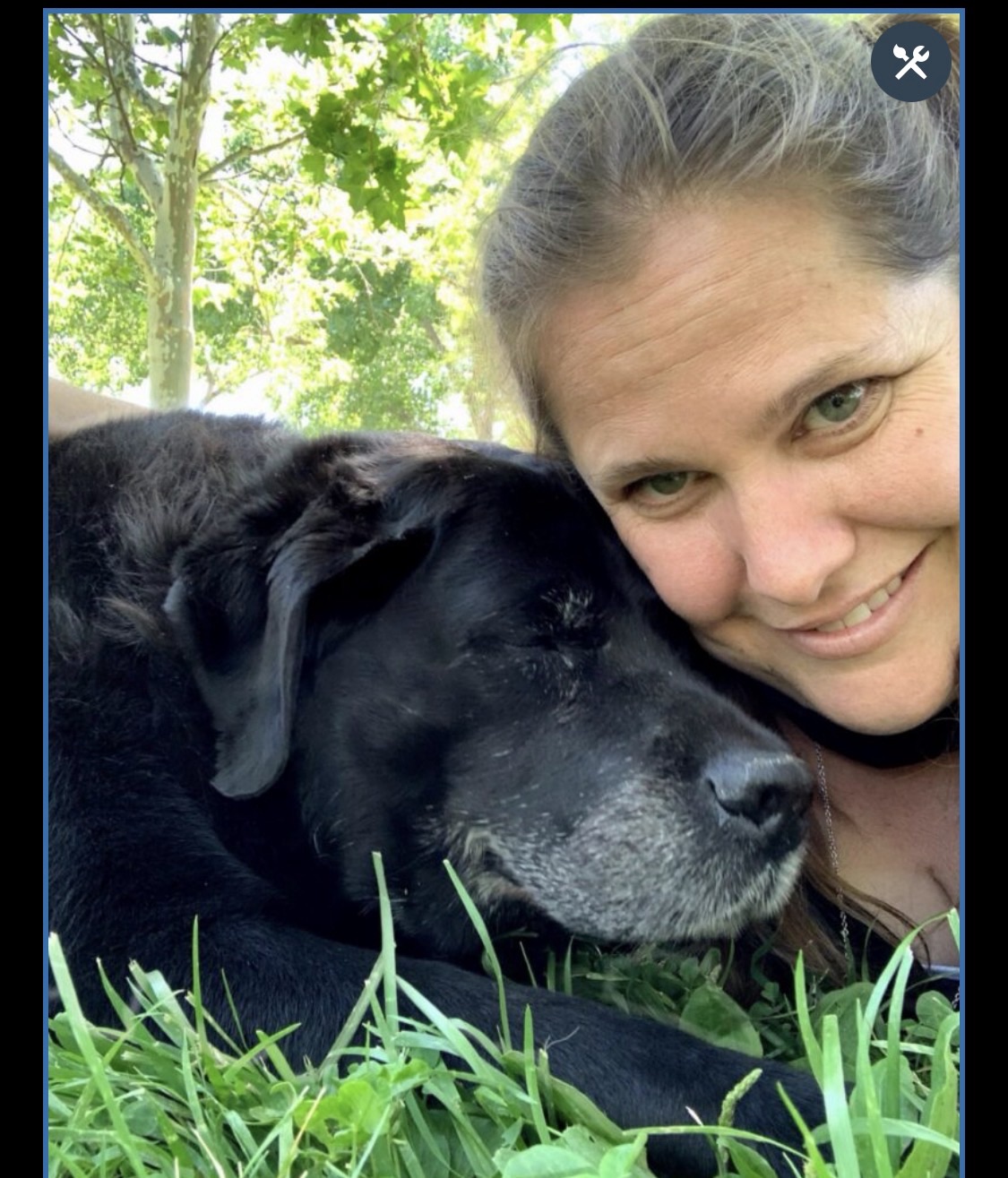
Image Description: Laura, a white woman, and Tabby, a black lab with a greying muzzle, lying side by side in the grass.
Introduction: After the denial, the harm continues
Part 1 of this series named rideshare discrimination against blind service dog handlers as ableism. This part asks what that ableism does. A denied ride can look brief from the outside: a driver cancels, leaves, or refuses to open the door. But for the person denied, the harm does not end when the car drives away. It can continue through the body, the schedule, the bank account, the family, the workplace, the next ride request, and the next decision about whether it is worth going out at all.
This article stands on its own, so I want to briefly reintroduce Tabby. Tabby was my service dog. After repeated rideshare denials and the cumulative stress attached to traveling with a guide dog, I made the painful decision after Tabby died not to get another guide dog. That decision was shaped by ableism, not by lack of value in guide dog partnership.
As a blind public health professional, I understand this experience as both personal and structural. This is not only about whether one driver breaks the law. It is about how repeated access denials, microaggressions, and consent violations can create public health harms: anticipatory stress, anxiety, hypervigilance, avoidance, social isolation, economic strain, embodied trauma-related responses, and loss of autonomy.
Anticipatory stress and the labor of preparing to be denied
One of the least visible harms of rideshare ableism is anticipatory stress. The denial does not begin only when the driver refuses. It begins when a rider opens the app and wonders whether this ride will become another fight.
Guide Dogs for the Blind documented this clearly. In its 2024 Rideshare Survey Report, GDB reported that ‘more than 46 percent’ of respondents experienced psychological impacts from rideshare denials, including anxiety, frustration, degradation, demoralization, stress, tension, uncertainty, and worry (Guide Dogs for the Blind, 2024). Those words describe the emotional labor of knowing that ordinary transportation may require self-defense.
Many blind service dog handlers develop routines to protect themselves: taking screenshots of the driver and vehicle, sending advance messages about the dog, building extra time into appointments, preparing legal language, saving customer support contacts, or budgeting for taxis if the ride fails. Those strategies may be practical, but they are also exhausting. They require disabled riders to do extra labor before they can access a service that nondisabled riders use without the same burden.
This is how ableism becomes embodied. The rider is not only responding to what happened last time. The rider is preparing the nervous system for what might happen this time.
Psychological and emotional impacts
Rideshare denials can produce shame, anger, fear, grief, and demoralization. They can also erode trust. After repeated denials, a rider may stop believing that a confirmed ride is actually confirmed. The app may say a driver is arriving, but the rider’s body may prepare for rejection.
The Seeing Eye documented a similar pattern in its 2024 access barriers report. It found that ‘approximately 80%’ of respondents who used rideshare had experienced a denial because of their guide dogs (The Seeing Eye, 2024). The report also described the emotional toll of denial attempts, even when the rider ultimately obtained access. One respondent explained that unsuccessful denial attempts can have a ‘chilling effect’ on future participation (The Seeing Eye, 2024).
This point is critical. The harm is not limited to completed denials. A driver who argues, complains, asks illegal questions, or pressures a rider to justify the dog can still cause harm even if the rider eventually gets in the car. A passenger can reach the destination and still carry the stress of being challenged, doubted, or treated as a problem.
When denials are repeated, the emotional impact can shift from an incident to a pattern of expected hostility. Riders may describe feeling anxious, exposed, powerless, or embarrassed. Some may avoid rideshare except when absolutely necessary. Some may stop taking their service dogs to certain places. Some may limit travel, not because they lack skills or desire, but because the systems around them have made access unpredictable.
Consent violations and the loss of autonomy
The thesis of this part is that the health impacts of rideshare ableism cannot be separated from consent and autonomy. A service denial does not only prevent movement. It tells the rider that someone else can decide whether their mobility tool is acceptable, whether their disability is believable, whether their body belongs in the vehicle, and whether their schedule matters.
Consent violations in rideshare can include being pressured to disclose disability information, being asked to prove the legitimacy of a service dog, being grabbed or guided without permission, being told to separate from the dog, or being forced to negotiate access in a public setting. These moments remove control from the rider and place it in the hands of a driver, company, or complaint system.
Autonomy matters because health is not only the absence of disease. It includes the ability to participate in public life, make decisions, maintain relationships, attend appointments, work, organize, date, parent, worship, and return home safely. When transportation access becomes conditional, autonomy becomes conditional too.
Microaggressions as cumulative harm
Not every harmful interaction is an outright refusal. Some harms are microaggressions: small or subtle actions that communicate disbelief, disrespect, or diminished personhood. Disability scholars describe ableist microaggressions as common everyday interactions that convey negative or disparaging messages to people with disabilities (Deroche et al., 2024). Keller and Galgay’s work identified domains such as denial of identity, denial of privacy, helplessness, patronization, second-class citizenship, minimization, denial of personhood, and otherization (Keller & Galgay, 2010).
In rideshare, denial of identity can occur when a driver asks a blind rider to prove the dog is real, legitimate, or necessary. Denial of privacy can occur when a rider is pressured to explain their disability. Helplessness can occur when a driver grabs, directs, or handles the rider without consent. Second-class citizenship can occur when a rider is told to cancel, wait for someone else, pay more, or accept conditions no other rider would be asked to accept.
These moments may seem small to observers. They are not small when they recur. They become a pattern of social communication: you are not believed, you are not welcome, you are not in control, and your access is conditional.
Embodied impact and trauma-related responses
The impacts of ableism are not only cognitive or emotional. They can be physical. Johnson, Leighton, and Caldwell (2018) argue that microaggressions have embodied dimensions, meaning that oppression is experienced and transmitted through the body as well as through language. Tone of voice, spatial pressure, unwanted touch, hesitation, refusal, and physical withdrawal can all communicate threat or exclusion.
This matters acutely for blind riders. Many blind people rely on nonvisual information such as sound, tone, pace, touch, vehicle position, traffic noise, and spatial cues. A driver who silently cancels and drives away creates practical confusion and physical vulnerability. A driver who raises their voice, refuses to unlock the door, demands proof, or reaches toward the rider without permission can trigger fear and heightened bodily alertness. A driver who complains throughout the trip can turn a ride into a captive environment of stress.
It is careful and accurate to describe these as trauma-related responses when the pattern produces hypervigilance, avoidance, and a sense of threat. That does not mean every person has post-traumatic stress disorder. It means that repeated discrimination can create PTSD-like patterns in the body: bracing, scanning, planning exits, anticipating refusal, avoiding triggers, and feeling unable to relax in situations that should be routine.
Research on discrimination and health supports the broader public health concern. Brondolo, Rieppi, Kelly, and Gerin (2003) reviewed literature on perceived racism and blood pressure, emphasizing discrimination as a social stressor with potential cardiovascular pathways. While that article focused on racism rather than ableism, the conceptual point is useful: repeated exposure to discrimination is not merely unpleasant. It can be a chronic stress exposure with biological and psychological consequences.
Public interference and the guide dog partnership
The health impact of rideshare discrimination is intensified by broader interference with guide dog teams. Allman, Freeberg, and Evans (2022) found that 89 percent of dog guide handlers had experienced people interfering with their dogs’ work at least occasionally by talking to or making eye contact with the dogs. This matters because public interference is a consent and safety issue, not just an etiquette problem.
In rideshare, the guide dog partnership is often treated as negotiable: can the dog stay home, sit somewhere else, ride in another car, or be treated as a pet? That framing misunderstands the relationship. Guide dogs can support confidence, navigation, independence, and safety. When transportation systems punish the presence of a guide dog, they attach discrimination to the very tool that supports mobility.
That is the most personal harm for me. After Tabby died, I did not simply weigh whether another dog would help me travel. I had to weigh whether I could endure the repeated confrontations, denials, and uncertainty that came with traveling with a service dog in rideshare systems. That is a devastating calculation. It means ableism did not only affect single trips. It affected a life decision.
Social isolation and the shrinking of public life
Rideshare discrimination also affects social participation. Guide Dogs for the Blind reported that ‘more than 27 percent’ of respondents experienced social impacts from rideshare denials (Guide Dogs for the Blind, 2024). The Seeing Eye found that more than 50 percent of U.S. respondents sometimes decide not to bring their guide dogs because of rideshare denial experiences (The Seeing Eye, 2024). Those statistics show how discrimination changes behavior.
A person may stop using rideshare for social events. A person may avoid dates, dinners, meetings, conventions, church, support groups, or community organizing. A parent may avoid taking children somewhere because being stranded with a child is too stressful. A professional may stop accepting opportunities that require unpredictable transportation. A person may stay home, not because they want isolation, but because systems outside the home have become unsafe, unreliable, or exhausting.
Social isolation is itself a public health issue. CDC states that social isolation and loneliness can increase risk for depression, anxiety, heart disease, stroke, dementia, self-harm, and earlier death (Centers for Disease Control and Prevention, 2024). When transportation barriers push disabled people away from public life, the effect is not only logistical. It is a health equity problem.
Economic impacts and the cost of discrimination
Economic harm is also part of the public health picture. Guide Dogs for the Blind reported that ‘approximately 16 percent’ of respondents cited economic impacts from rideshare denials (Guide Dogs for the Blind, 2024). Those impacts can include paying for alternative transportation, missing flights, missing work, arriving late to appointments, losing wages, losing opportunities, or being charged fees after a discriminatory cancellation.
Economic ableism occurs when disabled people are forced to pay more because systems are not accessible. If a rider has to order multiple cars before one driver will accept the service dog, that rider pays in time, stress, phone battery, risk, and sometimes money. If a rider has to use a taxi because rideshare drivers refuse service, that rider pays a disability surcharge created by discrimination. If a rider misses work, school, a medical appointment, or a job interview, the economic consequences may extend far beyond the cost of the ride.
Economic harm is not separate from health. Financial stress affects housing, food, medical care, safety, and mental well-being. Healthy People 2030 identifies transportation, economic stability, discrimination, and social context as conditions that shape health and quality of life (Office of Disease Prevention and Health Promotion, 2024).
Research gaps: What remains undermeasured
The current survey work is valuable, but it also shows why more research is needed. We need more studies that explicitly name ableism. We need research that examines service denials not only as legal incidents, but as cumulative public health exposures. We need data on chronic stress, trauma-related symptoms, avoidance behaviors, economic loss, family impacts, dating and relationship impacts, employment consequences, and the long-term effects on guide dog use.
We also need research that centers blind service dog handlers as authorities on their own experience. Community-based participatory research would allow blind riders to shape the questions, interpret the findings, and define what counts as harm. Without that, public health research may continue to miss the embodied and social costs that matter most in daily life.
The surveys have already opened the door. The next phase should connect disability rights, public health, trauma research, transportation policy, and disability justice in one shared framework.
Conclusion: Public health must include access, autonomy, and dignity
Rideshare denials are not isolated inconveniences. They are repeated exposures to ableism that can produce psychological, social, economic, and embodied harm. They can create anxiety before the ride, humiliation during the encounter, disruption after the denial, and avoidance long after the incident has passed.
Public health must take this seriously because transportation is tied to healthcare, employment, social connection, safety, and autonomy. A system that repeatedly blocks blind service dog handlers from reliable transportation is not only failing to comply with disability law. It is producing health inequity and violating consent by forcing disabled riders to repeatedly defend their right to exist in public space with their mobility tools.
Part 3 turns from impact to accountability. If Part 1 named ableism and Part 2 traced its public health consequences, Part 3 asks what must change: legally, culturally, technologically, and structurally.
References
Allman, M. R., Freeberg, K., & Evans, K. M. (2022). Interference with the work of dog guides in public: A survey. Journal of Visual Impairment & Blindness, 116(5), 607-616. https://doi.org/10.1177/0145482X221132540
Brondolo, E., Rieppi, R., Kelly, K. P., & Gerin, W. (2003). Perceived racism and blood pressure: A review of the literature and conceptual and methodological critique. Annals of Behavioral Medicine, 25(1), 55-65. https://doi.org/10.1207/S15324796ABM2501_08
Centers for Disease Control and Prevention. (2024). Health effects of social isolation and loneliness. https://www.cdc.gov/social-connectedness/risk-factors/index.html
Deroche, M. D., Ong, L. Z., & Cook, J. M. (2024). Ableist microaggressions, disability characteristics, and nondominant identities. The Professional Counselor, 13(4), 404-417. https://doi.org/10.15241/mdd.13.4.404
Guide Dogs for the Blind. (2024). Rideshare Survey Report. https://www.guidedogs.com/uploads/files/Landing-Pages/GDB-Rideshare-Survey-Report.pdf
Johnson, R., Leighton, L., & Caldwell, C. (2018). The embodied experience of microaggressions: Implications for clinical practice. Journal of Multicultural Counseling and Development, 46(3), 156-170. https://doi.org/10.1002/jmcd.12099
Keller, R. M., & Galgay, C. E. (2010). Microaggressive experiences of people with disabilities. In D. W. Sue (Ed.), Microaggressions and marginality: Manifestation, dynamics, and impact (pp. 241-267). Wiley.
Office of Disease Prevention and Health Promotion. (2024). Social determinants of health. Healthy People 2030. https://odphp.health.gov/healthypeople/priority-areas/social-determinants-health
The Seeing Eye. (2024). Public Access Barriers for Guide Dog Teams: Survey Report. https://seeingeye.org/wp-content/uploads/2024/07/access-survey-report-1.pdf
Author Note
This series was written by Laura Millar and draws on original writing, research, and lived experience developed over time. Portions of this work were compiled and edited with the support of AI tools to help organize and synthesize existing drafts and materials. The perspectives, analysis, and conclusions presented here are the author’s own.
One reply on “The Health Impacts of Rideshare Ableism: Consent, Trauma, Isolation, and Economic Harm”
[…] Part 2: The Health Impacts of Rideshare Ableism: Consent, Trauma, Isolation, and Economic Harm […]