
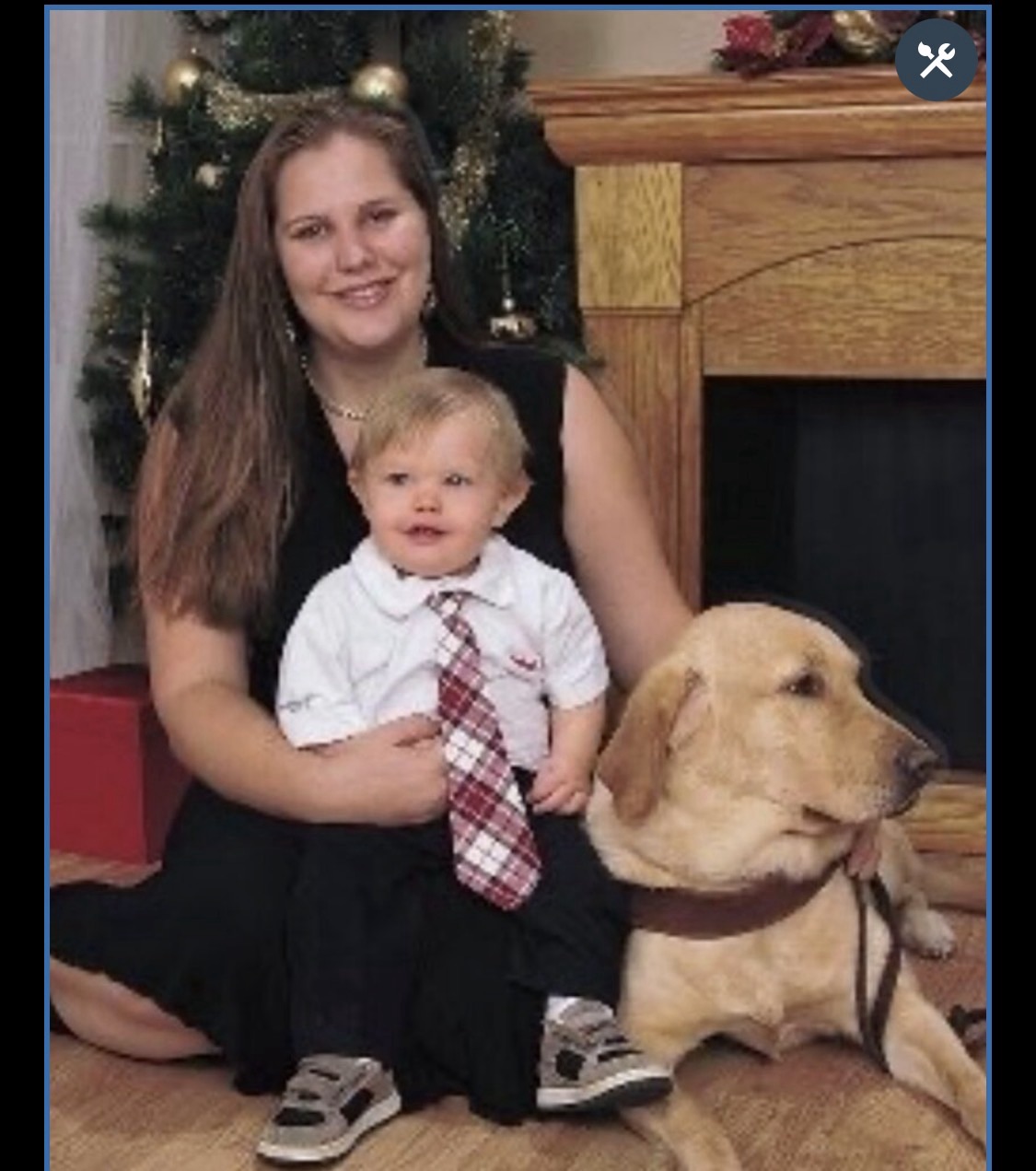
Image description:
Laura sits on the floor holding her young son, smiling. Merica her first yellow Labrador guide dog lies beside them. A Christmas tree and fireplace are in the background.
Introduction: This is not just a bad ride
Imagine standing outside in the heat with groceries at your feet, your child beside you, your phone battery almost gone, and your service dog waiting calmly at your side. A rideshare driver accepts the trip, pulls up, sees the dog, and drives away. Another driver accepts, arrives, sees the dog, and leaves. Then another. Each departure is treated by the platform like a canceled trip or a service problem, but for the person left on the curb it is something more: exposure, humiliation, uncertainty, and a loss of control over whether you can get home.
For me, this was not a one-time inconvenience. It became a pattern. Repeated rideshare denials affected my independence, my confidence, my willingness to go places, and my mental well-being. After my service dog Tabby passed away, I made the painful decision not to get another guide dog. That decision was not about whether a guide dog had value. It was about the weight of constant discrimination and the anxiety of never knowing whether transportation would appear, disappear, or turn into a confrontation.
I write about this as a blind public health professional and as someone whose life has been directly shaped by the problem. That dual perspective matters. Rideshare discrimination is often described with words like denial, access barrier, discrimination, or noncompliance. Those words are accurate, but incomplete. The pattern is also ableism. It is a public health issue. It is a consent and autonomy issue. It is a repeated demand that blind service dog handlers prove, defend, and negotiate their right to move through the world.
This first part names the problem. Existing survey work has done essential groundwork by documenting service denials and unequal treatment. This article builds from that work and invites a broader conversation: what changes when we explicitly call these patterns ableism, microaggressions, consent violations, and public health harms?
What the surveys have already shown
Guide Dogs for the Blind surveyed 185 guide dog users in the United States and Canada in early 2023. In its public summary of the findings, the organization reported that ‘more than 83 percent’ of respondents had been denied access when using rideshare with a guide dog (Guide Dogs for the Blind, 2024). The same report found that 82 percent of participants used rideshare services, and many used those services for multiple parts of daily life, including work, school, medical appointments, errands, worship, and social activities.
The Seeing Eye’s Public Access Barriers for Guide Dog Teams report reached a similar conclusion. In its rideshare section, The Seeing Eye reported that ‘approximately 80%’ of respondents who used rideshare in the United States and Canada had experienced a denial of service because of their guide dogs (The Seeing Eye, 2024). It also found that approximately 40 percent of those rideshare users were denied at least 25 percent of the time (The Seeing Eye, 2024).
These are not small numbers. They are evidence of a recurring pattern. When more than 80 percent of guide dog handlers in separate survey efforts report service denials, the problem cannot reasonably be framed as isolated driver confusion. The data point to a transportation system in which disability access is fragile, conditional, and inconsistently enforced.
The surveys also show that denial is only one layer of harm. The Seeing Eye reported that more than 50 percent of U.S. respondents sometimes decide not to bring their guide dogs because of rideshare denial experiences, and more than 50 percent of respondents had drivers who accepted rides but then complained about transporting the dog during the trip (The Seeing Eye, 2024). Guide Dogs for the Blind found that ‘more than 46 percent’ of respondents reported psychological impacts, ‘more than 27 percent’ reported social impacts, and ‘approximately 16 percent’ reported economic impacts from rideshare denials (Guide Dogs for the Blind, 2024).
That is the beginning of the public health argument. These denials do not simply interrupt travel. They shape behavior, constrain choices, affect emotional safety, and change how blind people plan their lives.
Why the word ableism matters
Ableism is discrimination and social prejudice against disabled people based on the belief that typical bodies, senses, and abilities are superior. Access Living explains that ableism is rooted in the assumption that disabled people need to be fixed and that it classifies disabled people as less than nondisabled people (Access Living, 2019). In rideshare, ableism appears when drivers, companies, and systems treat blind people with service dogs as exceptions, burdens, risks, or inconveniences rather than ordinary riders with equal rights.
Using the word ableism does not erase the legal language of disability discrimination. It deepens it. ADA noncompliance tells us a rule was broken. Ableism helps explain why the rule keeps being broken, why disabled riders are expected to absorb the consequences, and why the same barriers continue even when company policies say service animals are allowed.
This naming also matters because surveys and reports can document harm without always identifying the social mechanism behind that harm. That is not a dismissal of the work. It is an invitation to extend it. The surveys from Guide Dogs for the Blind and The Seeing Eye are essential because they document the pattern. The next step is to name the pattern as ableism so that public health professionals, policymakers, disability advocates, researchers, and rideshare companies can respond to the root cause rather than only the individual incident.
Ableism is also a consent and autonomy issue
Rideshare discrimination is often discussed as an access issue, and it is. But access alone does not capture the full harm. Consent and autonomy must be part of the thesis. Consent means that a person has the right to make decisions about their own body, mobility, personal space, communication, belongings, assistive tools, and service animal. Autonomy means having meaningful control over one’s movement and choices without unnecessary interference.
For a blind service dog handler, the dog is not a lifestyle accessory. The dog is part of how the person moves through the world safely and independently. When a driver demands proof, argues with the rider, pressures the rider to leave the dog behind, tells the rider to order a pet ride, or treats the dog as optional, the driver is not simply asking a question. The driver is challenging the rider’s autonomy.
When a platform allows these confrontations to happen repeatedly, the platform creates conditions where blind riders must negotiate access every time they try to travel. That is a consent problem. The rider is forced into unwanted disclosure, unwanted explanation, unwanted confrontation, and sometimes unwanted physical vulnerability in public space.
Forms of ableism in rideshare
Rideshare ableism is not one behavior. It is a cluster of behaviors and systems that reinforce each other.
Systemic ableism appears when platforms rely on after-the-fact complaint systems instead of preventing denials before they happen. If a blind rider has to file a report after being stranded, the system has already failed. If a company knows denials are common but leaves disabled riders to document, repeat, and relive those denials, the burden of enforcement has been shifted onto the people harmed.
Interpersonal ableism appears when a driver refuses service, drives away, demands proof, argues about allergies, expresses disgust, complains throughout the trip, or treats the rider as dishonest. These acts may be brief, but they are not minor. They communicate that the blind rider is less welcome, less credible, and less entitled to the same ride as anyone else.
Cultural ableism appears in the assumptions that guide dogs are pets, that blind people should expect extra scrutiny, that allergies or discomfort outweigh disability access, or that disabled people should be grateful for any service they receive. It also appears when the public treats service dog access as a favor rather than a civil right.
Technological ableism appears when apps, reporting pathways, customer support systems, or in-app driver tools are not designed around blind users’ needs. An app may be accessible enough to request a ride, but not accessible enough to prevent discrimination, preserve evidence, report a denial quickly, or secure a timely replacement ride.
Economic ableism appears when disabled riders are charged cancellation fees, cleaning fees, or higher costs after discrimination. It also appears when riders have to pay for taxis, miss appointments, lose work time, or avoid trips because rideshare has become too risky.
Microaggressions make the pattern visible
Microaggressions are not only individual rude comments. They are small, repeated acts that communicate disbelief, lower status, or exclusion. Disability microaggression frameworks describe patterns such as denial of identity, denial of privacy, helplessness, patronization, second-class citizenship, minimization, denial of personhood, and otherization (Keller & Galgay, 2010; Deroche et al., 2024).
In rideshare, denial of identity can sound like: Are you really blind? Do you really need the dog? Denial of privacy can occur when a rider is pressured to explain their disability to a stranger. Helplessness can occur when a driver grabs, steers, or directs the rider without asking. Patronization can sound like praise for ordinary competence. Second-class citizenship can occur when a rider is told to cancel, pay more, sit somewhere else, or accept conditions no other rider would be asked to accept.
These moments may be defended as misunderstanding, but their effect is cumulative. Each one makes the rider prove legitimacy. Each one turns transportation into a test of whether the rider will be believed. Each one teaches the rider that access is conditional.
Public interference with guide dogs is part of the same consent problem
The rideshare problem sits inside a broader pattern of public interference with guide dog teams. Allman, Freeberg, and Evans (2022) found that 89 percent of dog guide handlers had experienced people interfering with their dogs’ work at least occasionally by talking to or making eye contact with the dogs. Public interference with a guide dog is not harmless curiosity. It can distract a working dog, undermine safety, and violate the handler’s personal space and autonomy.
That same framework applies to rideshare. Touching the dog, questioning the dog, asking the rider to separate from the dog, or treating the dog as a pet are not small etiquette failures. They are access failures tied to consent and safety.
The legal baseline is clear, but policy alone is not enough
The ADA is clear that service animals are not pets. ADA.gov explains that service animals are dogs trained to perform tasks directly related to a person’s disability and that they are not required to wear a vest, ID, or other identifying equipment (U.S. Department of Justice, 2020, 2024). When it is not obvious what service the animal provides, staff may ask only two questions: whether the animal is required because of a disability and what work or task the animal has been trained to perform. Staff may not demand documentation, require a special ID, ask the animal to demonstrate the task, or ask about the person’s disability (U.S. Department of Justice, 2020).
The problem is not that blind service dog handlers lack legal language. Many know the law well. The problem is that knowing the law does not guarantee a ride. A rider can know their rights and still be left on the curb. A rider can report discrimination and still experience it again. A rider can educate one driver and still face the same problem tomorrow.
Conclusion: We cannot solve what we refuse to name
Rideshare discrimination against blind service dog handlers is not only a customer service failure. It is not only a legal violation. It is ableism expressed through transportation systems, app design, driver behavior, weak enforcement, and public misunderstanding. It is also a consent and autonomy violation because it forces blind riders into repeated unwanted disclosure, negotiation, and loss of control over movement.
As a public health issue, it affects stress, social participation, economic security, healthcare access, family life, dating, employment, and guide dog partnership. The surveys have already shown the pattern. Naming ableism gives us the language to understand the mechanism behind it.
Part 2 builds from this foundation. If Part 1 names the problem, Part 2 asks what repeated ableism does to the mind, body, relationships, finances, and daily life of blind service dog handlers.
References
Access Living. (2019). Ableism 101. https://www.accessliving.org/newsroom/blog/ableism-101/
Allman, M. R., Freeberg, K., & Evans, K. M. (2022). Interference with the work of dog guides in public: A survey. Journal of Visual Impairment & Blindness, 116(5), 607-616. https://doi.org/10.1177/0145482X221132540
Deroche, M. D., Ong, L. Z., & Cook, J. M. (2024). Ableist microaggressions, disability characteristics, and nondominant identities. The Professional Counselor, 13(4), 404-417. https://doi.org/10.15241/mdd.13.4.404
Guide Dogs for the Blind. (2024). Rideshare Survey Report. https://www.guidedogs.com/uploads/files/Landing-Pages/GDB-Rideshare-Survey-Report.pdf
Keller, R. M., & Galgay, C. E. (2010). Microaggressive experiences of people with disabilities. In D. W. Sue (Ed.), Microaggressions and marginality: Manifestation, dynamics, and impact (pp. 241-267). Wiley.
The Seeing Eye. (2024). Public Access Barriers for Guide Dog Teams: Survey Report. https://seeingeye.org/wp-content/uploads/2024/07/access-survey-report-1.pdf
U.S. Department of Justice. (2020). Frequently asked questions about service animals and the ADA. ADA.gov. https://www.ada.gov/resources/service-animals-faqs/
U.S. Department of Justice. (2024). Service animals. ADA.gov. https://www.ada.gov/topics/service-animals/
Author Note
This series was written by Laura Millar and draws on original writing, research, and lived experience developed over time. Portions of this work were compiled and edited with the support of AI tools to help organize and synthesize existing drafts and materials. The perspectives, analysis, and conclusions presented here are the author’s own.
One reply on “Ableism in Rideshare: Naming the Public Health and Consent Crisis Behind Service Dog Denials”
[…] Part 1: Ableism in Rideshare: Naming the Public Health and Consent Crisis Behind Service Dog Denials […]