When I began losing my vision, I wondered who would want to date me, hire me, or build a life with me. I had absorbed the idea that blindness made me less capable and less desirable. I did not yet have the community, language, or experience to challenge what I had been taught.
Blind community changed that. Learning alongside other blind people helped me understand how much of what I had feared came from ableism, inaccessible environments, and low expectations.
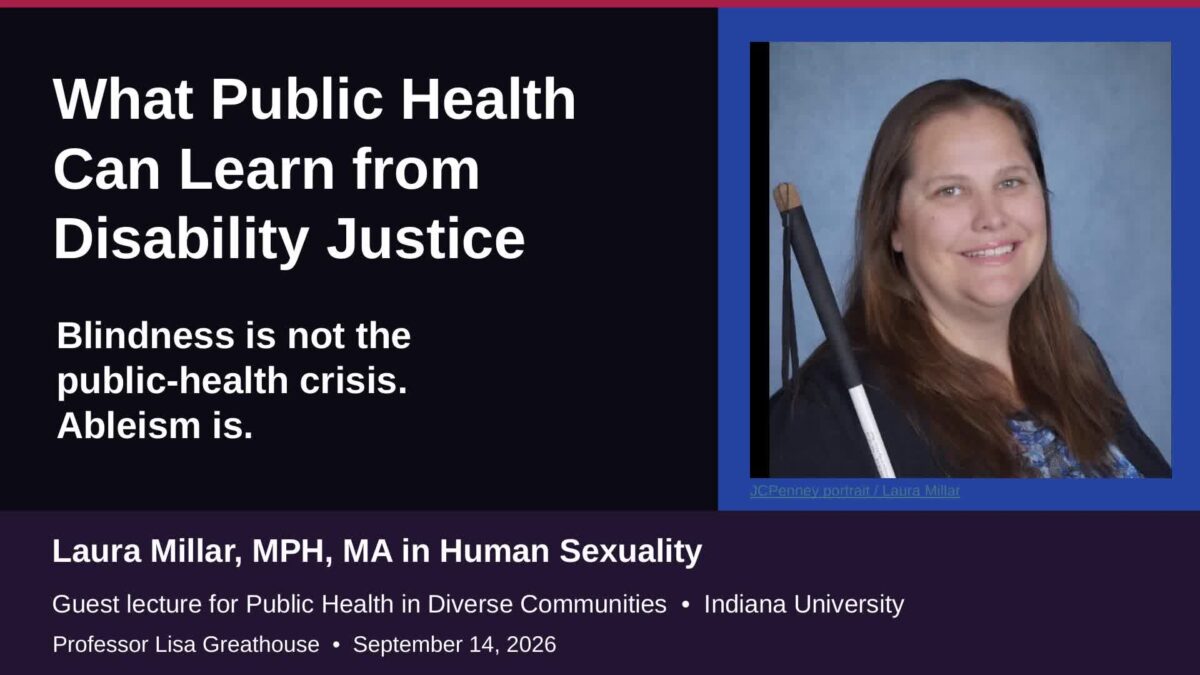
That journey is at the heart of my lecture, What Public Health Can Learn from Disability Justice, now available on YouTube. I prepared it for Professor Lisa Greathouse’s Public Health in Diverse Communities class at Indiana University. I am sharing it more widely because these questions belong in our classrooms, clinics, organizations, and everyday work.
The recording runs approximately 53 minutes and includes on-screen captions and spoken descriptions of visual content.
Community changed the questions I asked
Medical care helped name and monitor my retinitis pigmentosa. Rehabilitation gave me skills, tools, and support. At the Colorado Center for the Blind, I experienced what it meant to learn in a community where blind people were teachers, administrators, and peers.
I encountered people living the full lives I had struggled to imagine for myself. That changed what I believed was possible. It also changed my work as a public health and sexual health professional.
I began asking different questions. Who designed this service? Whose knowledge shaped it? What assumptions are being made about disabled people’s relationships, parenting, sexuality, or ability to make decisions?
Those questions can change an entire program.
Access shapes health and autonomy
In the lecture, I ask students to imagine an evacuation map that tells people to leave the areas marked in red. If my screen reader only announces “image,” the warning has failed to tell me whether my home is in danger or where I should go.
The same problem appears in health portals, registration forms, sexual health information, and follow-up instructions. When information is inaccessible, people may have to disclose private information to someone else just to use a service.
As a blind parent, I added tactile puff-paint markings to my baby’s Pavlik hip harness so I could align the straps by touch. The doctor wanted to share the idea with other families. I wanted students to understand both parts of that story: the value of disabled people’s expertise and the pressure we can feel to prove that we are capable of caring for our own children.
Access changes who can participate, whose privacy is protected, and who gets to remain in charge of their life.
What disability justice asks of public health
The lecture uses the ten principles shared by Sins Invalid to think about public health practice. I credit that movement knowledge because these principles come from disabled organizing, and public health has much to learn from it.
Leadership by those most impacted asks who has the power to change a decision. Recognizing wholeness asks whether our programs make room for sexuality, pleasure, parenting, and belonging. Collective access asks us to share responsibility for making participation possible. Sustainability asks whether our work allows people to rest and remain part of the community when their capacity changes.
These questions require us to examine our budgets, relationships, and definitions of success.
If a workshop has low attendance, we need to learn from people who could not attend. If a patient cannot use the follow-up plan, we need to examine the handoff. If disabled people are invited into a project, their leadership needs to influence what happens.
Watch and bring the conversation into your work
Please share this lecture with students, public health colleagues, healthcare teams, educators, and community organizers.
As you watch, consider one place in your work where a barrier has been attributed to the person encountering it. What would change if the organization took responsibility for making that setting usable?
Watch the full lecture on YouTube.
Support this work
If this lecture is useful to you and you have the means, your support helps sustain the education, writing, and community organizing I share.
Contributions support my independent work and are not tax-deductible charitable donations.