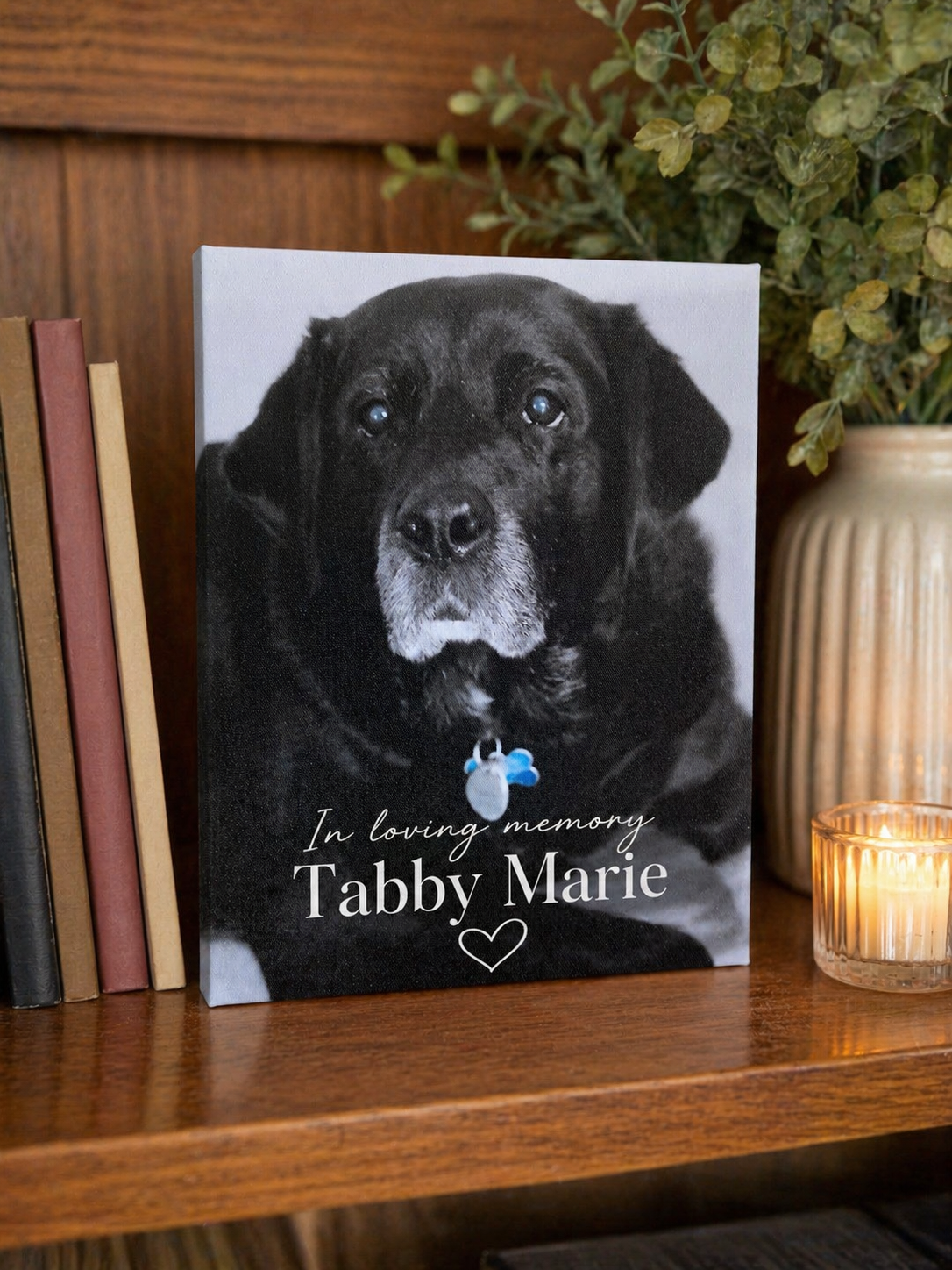
Image description: A memorial canvas of Tabby Marie, a retired black guide dog with a greying muzzle, displayed on a bookshelf beside a candle. The text reads, “In loving memory Tabby Marie,” with a small heart.
This three-part series does something that existing research, reporting, and advocacy have not yet fully done.
It names rideshare discrimination against blind service dog handlers as ableism, as a pattern of consent violations, and as a public health issue.
Surveys and reports have documented what is happening. They show high rates of service denial, widespread misunderstanding of service animals, and the emotional toll of these experiences. That work matters. It gives us data, documentation, and a foundation for advocacy.
What has been missing is the framework.
Without naming ableism directly, the problem is often reduced to inconvenience, misunderstanding, or individual driver behavior. Without a public health lens, the impact is treated as isolated instead of cumulative. Without naming consent, repeated violations of autonomy remain normalized.
This series builds on existing work by making those connections explicit.
Each post stands on its own. Together, they show how ableism operates across systems, interactions, and outcomes, and why this matters for health, autonomy, dignity, and full participation in public life.
The first post establishes the foundation for the series.
Rideshare discrimination is not random, and it is not rare. It follows patterns. Blind service dog handlers are denied rides, questioned about their dogs, charged inappropriate fees, ignored, stranded, and forced to defend their right to use transportation services that are supposed to be available to the public.
This post names those patterns as ableism.
It also explains how rideshare discrimination shows up as microaggressions and consent violations. These are not just uncomfortable interactions. They are repeated moments where disabled people are required to justify their presence, prove their legitimacy, and absorb the consequences of other people’s assumptions.
By naming these dynamics clearly, the issue shifts from isolated incidents to systemic behavior. It also shifts the conversation from frustration to measurable harm.
Read Part 1: Ableism in Rideshare: Naming the Public Health and Consent Crisis Behind Service Dog Denials
The second post focuses on impact.
When discrimination happens repeatedly, it does not end at the moment of denial. It accumulates. A denied ride can mean a missed medical appointment, a missed work shift, a canceled social event, or being stranded in unsafe conditions. But the harm is not only logistical. It is psychological, physical, social, and economic.
This post examines how rideshare ableism affects health through chronic stress, anticipatory anxiety, trauma-related responses, social isolation, and financial strain.
It also explores how repeated consent violations affect both psychological and physical well-being. For blind people, these experiences are often shaped through tone of voice, touch, spatial uncertainty, and the need to constantly assess safety without access to the same visual information others may rely on.
Framed this way, rideshare discrimination is not just about transportation access. It is about health.
Read Part 2: The Health Impacts of Rideshare Ableism: Consent, Trauma, Isolation, and Economic Harm
The third post turns toward accountability and reform.
If the problem is systemic, the response must also be systemic. Rideshare discrimination cannot be solved by asking blind service dog handlers to report, educate, explain, document, and advocate every time they are denied a ride.
This post outlines legal, policy, cultural, and public health changes needed to address rideshare discrimination in a meaningful way.
It calls for stronger enforcement, clearer accountability, better training, more accessible reporting systems, and the integration of consent-based interaction as a standard. Access should not depend on whether someone is willing or able to advocate for themselves in the moment. It should be built into systems that are reliable, predictable, and equitable.
Part 3 also makes clear that naming ableism is not only descriptive. It is part of the solution. When the root cause is named, policy can become more precise, enforcement can become more targeted, and public health interventions can become more effective.
Read Part 3: From Rideshare Ableism to Accountability: Consent, Enforcement, and Public Health Reform
Why This Series Matters
This series is both personal and professional.
As a blind public health professional, I have experienced these barriers directly and have seen their impact across the community. The goal of this work is to make these patterns visible, to name them clearly, and to connect them to broader conversations about health, equity, consent, and rights.
If ableism is not named, it cannot be addressed.
If harm is not framed as public health, it is easier to dismiss.
If consent is not centered, violations remain normalized.
This series brings those pieces together.
Start the Series
- Part 1: Ableism in Rideshare: Naming the Public Health and Consent Crisis Behind Service Dog Denials
- Part 2: The Health Impacts of Rideshare Ableism: Consent, Trauma, Isolation, and Economic Harm
- Part 3: From Rideshare Ableism to Accountability: Consent, Enforcement, and Public Health Reform