The questions about blindness and intimacy you’ve wanted to ask but didn’t know how.
Featured image description
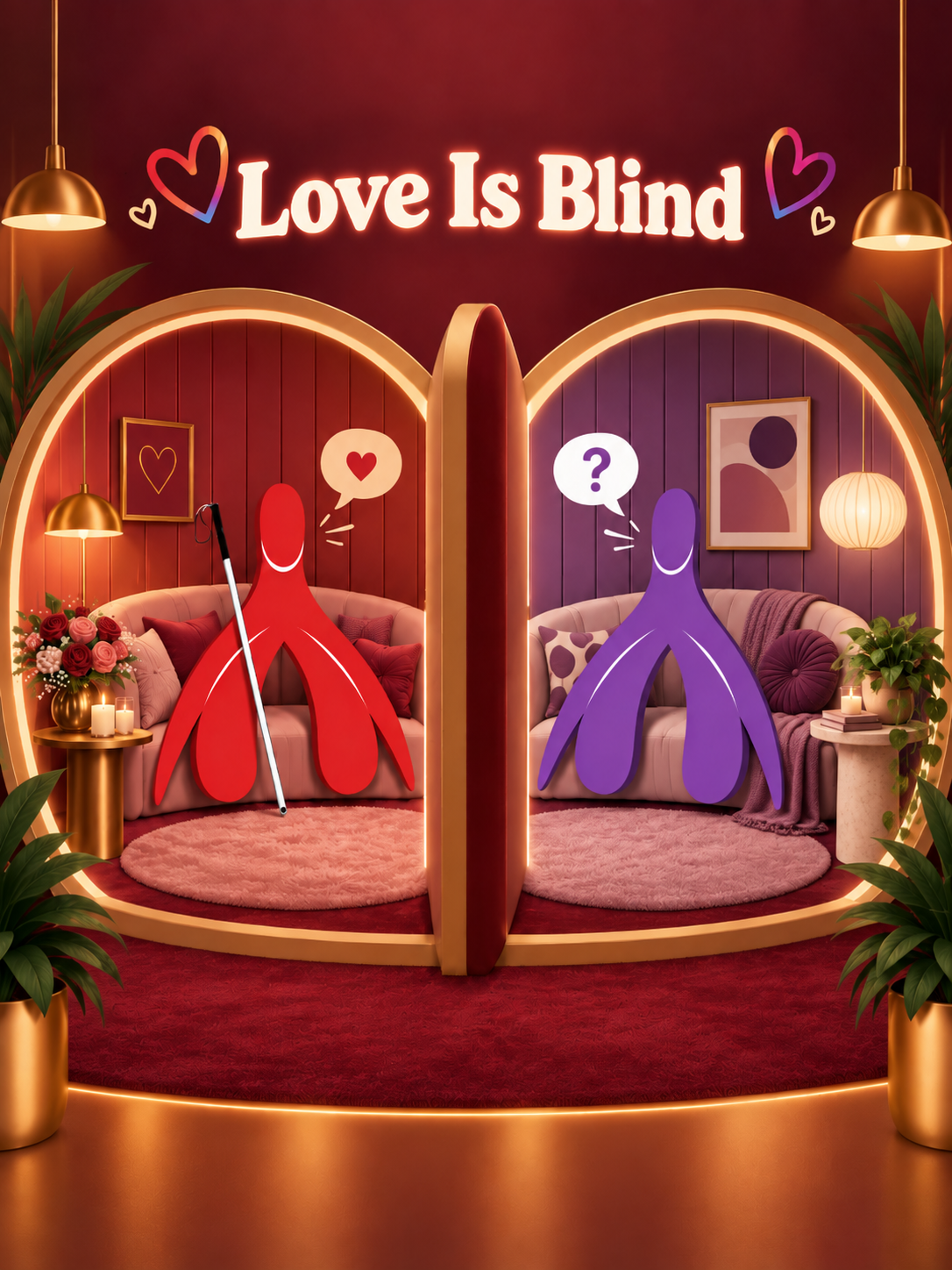
A portrait-format illustration in burgundy, gold, pink, and purple. Large glowing cream letters at the top read “Love Is Blind,” with colorful heart outlines on either side. Below, two gold-rimmed dating pods stand side by side, separated by a tall curved wall. Each contains a sofa and a smiling, stylized clitoris character. In the left pod, the red character has a long white cane with a black handle leaning diagonally in front of it. A speech bubble above it contains a red heart. The left room has red wall panels, roses, candles, and a gold lamp. In the right pod, the purple character has no cane. Its speech bubble contains a purple question mark. The right room has purple wall panels, abstract artwork, a round lantern, cushions, a draped blanket, and a trailing plant. Pink rugs and large green plants complete the scene.
Netflix’s Love Is Blind asks people to choose a potential spouse before seeing them. They talk through a wall, build a connection, and get engaged before meeting face to face. Then comes the question: will that connection survive the reveal and life outside the pods? [Source 1]
As a blind sexologist, I have a question that starts a little earlier.
How do I know someone is interested in me if I cannot see them looking at me from across the room?
Before the engagement, before the first kiss, before anyone debates whether physical attraction matters, there is the small matter of figuring out whether someone is flirting.
Over the past decade, my work as a sexual health professional has centered on blindness, sexuality, dating, intimacy, and relationships, and on listening to the experiences people share with me. Those conversations do not describe one universal blind experience. They do raise questions that deserve more attention than they usually get.
Questions about attraction. About access. About whether someone wants to get to know you or has simply decided you need assistance.
You do not have to stop enjoying Love Is Blind to examine the assumptions surrounding it. But we should talk about what “blind” is doing in that title, and what actual blind people can contribute to this conversation.
Not because we are better at love, but because we are part of it.
How do I know they are interested?
Sometimes, you do not know. At least, not yet.
When someone’s only expression of interest is a look you cannot access, that signal may never reach you. There is no secret blind-person flirting detector that makes up for information you did not receive.
But sight is not mind reading, either.
Seeing someone look at you and understanding what that look means are two different things. In a study involving 104 heterosexual strangers, participants were better at recognizing interactions where flirting had not occurred than ones where it had. One study cannot represent everyone’s dating life, but it shows why romantic interest should not be treated as self-evident. [Source 2]
Missing a glance because you cannot see it is different from noticing one and being unsure what it means. Both can leave someone wondering whether an opportunity passed them by.
Here is the distinction I want us to remember: not receiving a signal is not the same as being rejected.
It does not prove someone is interested, either. Missing information is not an answer.
The pods help us notice something. Before any connection develops, the show has already arranged an introduction. Participants have scheduled conversations, and mutual interest helps decide who gets another date. No one first has to catch a stranger’s attention across a room. [Source 1]
That does not guarantee attraction. It does create an opportunity for attraction to develop or become apparent.
Outside the pods, we have to create that opening ourselves. And the responsibility should not fall entirely on the person who cannot see the signal.
Flirting needs more than an audience of one
If you are the one expressing interest, consider whether your invitation is actually reaching the person you hope will respond.
Approach within a comfortable conversational distance, introduce yourself, and make it clear whom you are addressing.
“Hi, I’m Alex. We were talking earlier, and I’d like to get to know you better.”
Or, after some conversation:
“I’m enjoying this. Would you like to get coffee sometime, as a date?”
“As a date” does useful work. It separates an invitation from a possible networking opportunity with better lighting.
If you are the blind person wondering about someone’s interest, you have options, too.
“I don’t reliably catch looks across a room. Come say hello.”
Or:
“I can’t quite tell whether we’re flirting. Are we?”
You can also express your own interest rather than waiting to confirm theirs first.
“I’d enjoy spending more time with you. Would you be interested in a date?”
These are examples, not required scripts. Use the language and communication methods that work for you.
A trusted friend can help with introductions or describe something you missed, when you have asked for that support. But sharing an observation is different from deciding what it means. “Someone has been looking in your direction” is information. “They definitely want you” is an interpretation.
Support should not turn into taking over. An introduction is not permission to disclose someone’s personal information, negotiate their romantic life, or decide who would be “good for them.”
None of these approaches guarantees the answer you hope for. Clear communication does not remove the vulnerability of expressing interest. It gives the other person something they can understand and respond to.
The goal is not to eliminate uncertainty from dating. It is to stop treating an inaccessible or ambiguous signal as a stand-in for an actual invitation.
Are they flirting with me, or do they think I need help?
This question comes up in my professional conversations.
Someone approaches. They are attentive. They ask questions. They stay nearby.
Are they interested? Friendly? Concerned? Have they decided that a blind person standing alone must be waiting for assistance?
Offering help is not bad, and not every friendly interaction needs to become a romantic possibility. The point is that the role someone assigns you shapes the interaction.
Are you a person they might want to know, or a problem they have arrived to solve?
That brings us to sexual ableism. When I use the term, I mean assumptions and practices that treat disabled people as less entitled to desire, pleasure, sexual information, boundaries, and relationships, or less capable of making choices about them. Disability and sexuality scholars have examined how portraying disabled people as passive and dependent feeds their desexualization. [Source 3]
Desexualization means treating someone as though desire and sexuality do not belong to them. Infantilization means treating an adult as though they were a child. Neither leaves much room for an adult with preferences, boundaries, and a romantic life of their own.
Consider the difference between asking, “Would someone date a blind person?” and asking, “What does this blind person want in a partner?”
The first positions us as people waiting to be accepted. The second recognizes that we also get to assess, desire, decline, and choose.
In the moment, you might clarify:
“Thanks, I’m all set for help. I would enjoy talking with you, though.”
Or you might need assistance and still be interested in the person offering it. Those are not mutually exclusive. You should not have to pretend you never need help to be recognized as desirable.
But assistance is not a romantic contract. Accepting it creates no debt of attention, affection, or access to someone’s body. A freely chosen sexual interaction is not something another person earns by being helpful.
And being blind does not turn someone’s interest in us into an act of charity.
Love is blind. What are we actually saying?
The phrase can sound romantic: love reaches beyond appearances.
It can also sound like a warning: someone is so infatuated that they are overlooking information they should take seriously.
Neither meaning describes how blind people love.
Blindness is not a personality trait, a relationship philosophy, or an exemption from questionable taste.
It is also not one uniform visual experience. Some blind people have no sight. Others have usable vision, with big differences in what they can perceive and under what conditions. Blindness does not mean everyone lives in complete darkness. [Source 4]
So the assumption that blind people cannot care about appearance starts with a misunderstanding. The idea that we must therefore care only about personality adds another.
We are not above physical attraction. The signals we tune into may simply shift.
Physical attraction and visual attraction are not interchangeable. A voice is physical. So is scent. So is the experience of wanted touch. Research on attraction among blind and sighted people has looked at these different sources of sensory information rather than treating attraction as purely visual. [Source 5]
Finding someone’s voice attractive is not the same as admiring their values. A beautiful voice can belong to someone you would be very wise not to date.
Nor does blindness erase interest in physical attractiveness. In a small 2021 study, blind women rated its importance about the same as sighted women, while blind men rated it lower than sighted men. Those findings cannot speak for an entire community. They do give us reason to question the story that blind people simply do not care about bodies. [Source 5]
We do not need to replace “everyone cares about looks” with “everyone cares about voices.” We need to stop treating one route to attraction as the definition of attraction itself.
And please do not replace the stigma with a pedestal.
The idea that blind people love more deeply, communicate more honestly, or are less superficial can sound like a compliment. It still assigns us a personality based on disability.
The same problem shows up in the supposed compliment that a sighted partner must be extraordinary for dating someone blind. What happens to the blind partner in that story? Are they desirable, funny, interesting, sexually compatible? Or have they become evidence of someone else’s goodness?
I am not interested in trading the idea that we are undesirable for the idea that we are morally superior.
I am interested in making room for us to be people.
The pods are not a simulation of blind dating
Not seeing someone is not the same as being separated from them.
The show’s pods are separate rooms connected by audio, with an opaque wall blocking visual contact. That setup also removes the ordinary physical closeness of sharing a space. [Source 1]
Blind dating does not require a wall.
A date can include a shared meal, movement, laughter, and physical closeness when both people want it. The absence of sight does not require the absence of a body.
That makes the reveal more complicated than a simple test of whether love can overcome appearance. People are also meeting in a new setting, with different sensory information and new possibilities for interaction.
My concern is with treating that moment as the arrival of the “real” person.
The person on the other side of the wall was already real. Their body did not suddenly come into existence when someone could look at it.
I also want us to question the moral test we attach to the reveal. Finding that attraction changes does not automatically make someone shallow. Staying in the relationship does not automatically prove someone has transcended superficiality.
No one owes another person attraction, including someone they have shared meaningful conversations with.
That applies to blind people, too. We are allowed to discover that a connection is not what we want. We are not obligated to make a relationship work to prove that love without sight is possible.
Does asking ruin the moment?
“I’d like to kiss you. Would you like that?” is an invitation, not a technical malfunction in romance.
But asking is only the beginning.
What matters is whether the other person can respond freely, whether you understand their answer, and whether you respect it. Consent must be voluntary, specific to the activity, and open to change. Agreeing to a date is not agreeing to a kiss. Agreeing to a kiss is not agreeing to anything else. [Source 6]
This is where accessible communication and consent culture meet.
By consent culture, I mean making choice and respect an ordinary part of interaction, rather than treating permission as a hurdle to clear on the way to what you want.
That starts long before anyone reaches a bedroom. Ask before touching or guiding someone. Offer assistance rather than taking control. Accept that someone can appreciate your offer and still decline it. Let them tell you what works.
Then carry that same respect into flirting and intimacy.
A clear question does not, by itself, establish safety or mutual desire. Someone may feel pressured to agree. They may be uncertain. They may change their mind. A refusal can be quiet, indirect, or nonverbal, and it still needs to be respected. Silence is not agreement. When consent is unclear, stop and check rather than treating uncertainty as permission. [Source 7]
Clarity also does not require everyone to speak.
Spoken words, text, sign language, and communication devices can all express a choice. The standard should be communication the people involved can access and understand, not a single approved way of producing a yes or a no. Consent does not always have to be verbal. [Source 8]
Replacing “everyone must see” with “everyone must speak” would just reproduce the same problem in another form.
For partners, a useful conversation might be: “What works for us when we want to continue, pause, change something, or stop?”
That conversation should support choice, not make someone responsible for delivering a perfectly scripted refusal. No one should have to perform distress convincingly to have a boundary respected.
And we do not have to ban subtlety. Teasing, glances, and playful ambiguity can stay part of flirting. The difference is that a possible expression of interest is not consent to sexual activity.
Keep the playfulness. Do not make someone’s permission the part you guess about.
A few more questions you do not have to whisper
Do blind people touch someone’s face to find out whether they are attractive?
That is not a universal blind dating ritual.
The authors of the 2021 attraction study specifically cautioned against this assumption. They noted informal conversations in which blind participants linked touching a potential partner’s face or body with intimacy already established, not with routinely assessing attractiveness. [Source 5]
Someone’s face is not an object available for inspection. Touch belongs in the same conversation about permission as everything else.
How do blind people have sex?
There is no single “blind way” to have sex, just as there is no single sighted way.
A useful conversation starts with the people involved: what they want, what information they need, what communication works for them, and what feels comfortable or pleasurable.
Someone might appreciate a description, a direct question, or guidance they have asked for. Partners might agree to guide each other’s hands or describe a movement. Someone else might not want any of that. These are possibilities to discuss, not instructions to apply automatically because someone is blind.
“What would feel good?” and “Would you like me to describe that?” are better starting points than assuming you already know what their body or their blindness requires.
There also has to be room for people who do not want sex or romantic relationships. Nobody owes anyone an active sex life to prove that disabled people are fully human. [Source 9]
The question itself does not need to be forbidden. But asking a sex educator about accessibility and intimacy is different from expecting a blind stranger to explain their private life.
Curiosity deserves somewhere to go. It does not create an entitlement to somebody else’s bedroom.
What nonvisual intimacy can teach everybody
The lesson is not that everyone should close their eyes.
It is that everyone can question what they have been treating as obvious.
What information are you relying on? What are you assuming? Have you made your interest understandable? Have you left room for the other person to want something different?
Blind people do not always get this right. We do not receive advanced communication skills with a diagnosis. But experiences of nonvisual intimacy challenge the idea that connection has one natural sequence: look, interpret, approach, somehow know.
There are other ways to express interest, learn about a body, communicate uncertainty, and build a relationship.
Blind people deserve access to desire, pleasure, relationships, and choice whether or not sighted people learn anything from us. Our inclusion does not need to prove its usefulness to anyone else.
Still, these perspectives offer something worth considering beyond the blind community. What becomes possible when we expand the ways people can connect, rather than asking everyone to master one set of signals?
That is why accessibility belongs in this conversation. Not as a special favor after the romance begins, but as part of how people get the chance to connect in the first place.
Clearer flirting will not resolve every form of sexual ableism. It can challenge the expectation that the person missing information must do all the adapting.
You cannot build a connection together while making access to it one person’s job.
Let’s have the conversation the title leaves out
Love Is Blind gives us a reason to talk about attraction. I want us to use that opening for more than a debate about whether looks matter.
For people making dating shows, interviewing couples, or telling relationship stories, there are other questions worth asking.
Does a blind person get to be the one choosing, or does the story focus on whether someone else will accept them? Can they talk about access without becoming a problem to be solved? Is there room for them to be desirable, funny, sexual, awkward, uncertain, or uninterested?
Those are storytelling questions, not just questions about using the right terminology.
For educators and people navigating their own relationships, the question is just as practical: are we making room for different ways of expressing interest and making choices, or expecting people to work around barriers we could address together?
Blind people are not a romantic experiment. We do not need to prove that love is possible without sight. We need room to describe what attraction, pleasure, uncertainty, rejection, and connection involve without becoming either a cautionary tale or an inspiration.
And we need places where people can bring the questions they have been afraid to ask.
What have you wanted to ask about blindness, attraction, dating, or sex, but not known how to ask?
Share your question in the comments or email me at laura@lauramillar.com. Whether you are watching a dating show, making one, teaching about relationships, or navigating your own, you do not need a perfectly worded question to begin.
Keep the chemistry. Make room for more ways to express it. The goal is not to make everyone flirt the same way.
It is to make sure the possibility of connection does not end with a look the other person never received.
About the Author
Laura Millar, MPH, MA, is a sexologist, sociologist, and public health professional with more than 20 years of experience working at the intersection of consent culture, sexual health, and disability. She was the 2025 Carrie Buck Distinguished Fellow at the Lurie Institute for Disability Policy at Brandeis University. She serves as Second Vice President of the NFB San Francisco Chapter and on the board of NFB California.
Through Laura Millar Consulting and Coaching, Laura works with educators, organizations, media makers, and individuals who want to talk about disability, dating, and sexuality with more honesty and less guesswork. Want to bring this conversation to your classroom, staff, production, or community? Reach out via email at laura@lauramillar.com or visit lauramillar.com.
Get new posts by email
Want more conversations about sexuality, consent, and disability justice? Subscribe to my blog to receive new posts by email. Enter your email address below, select Subscribe, and check your inbox for an email asking you to confirm your subscription. You do not need to leave a comment.
AI Disclosure
This post was developed by Laura Millar with AI-assisted editorial support for drafting, organization, clarity, accessibility, and research support. The analysis, perspective, professional experience, and final editorial decisions are Laura’s. AI was used as a writing support tool, not as a substitute for professional expertise, community knowledge, or the experiences shared by Blind people. The featured illustration was also created with generative AI under Laura’s direction.
Sources
Source 1. Charlotte Walsh. “No, There Aren’t Any Bathrooms in the Love Is Blind Pods.” Netflix Tudum, March 7, 2025.
https://www.netflix.com/tudum/articles/love-is-blind-pods
Source 2. Jeffrey A. Hall, Chong Xing, and Seth Brooks. “Accurately Detecting Flirting: Error Management Theory, the Traditional Sexual Script, and Flirting Base Rate.” Communication Research, 42(7), 939-958, 2015. First published online in 2014.
https://doi.org/10.1177/0093650214534972
Source 3. Ana Cristina Santos and Ana Lúcia Santos. “Yes, we fuck! Challenging the misfit sexual body through disabled women’s narratives.” Sexualities, 21(3), 2018. First published online in 2017.
https://doi.org/10.1177/1363460716688680
Source 4. Royal National Institute of Blind People. “What we know about public attitudes and understanding.” December 20, 2023.
https://www.rnib.org.uk/professionals/research-and-data/reports-and-insight/what-we-know-about-public-attitudes-and-understanding/
Source 5. M. Scheller, F. Matorres, A. C. Little, L. Tompkins, and A. A. de Sousa. “The Role of Vision in the Emergence of Mate Preferences.” Archives of Sexual Behavior, 50, 3785-3797, 2021.
https://link.springer.com/article/10.1007/s10508-020-01901-w
Source 6. Planned Parenthood. “Sexual Consent.”
https://www.plannedparenthood.org/learn/relationships/sexual-consent
Source 7. RAINN. “Consent 101: Respect, Boundaries, and Building Trust.” Updated May 31, 2026.
https://rainn.org/5-rules-for-getting-consent/
Source 8. American Association of Sexuality Educators, Counselors and Therapists. “AASECT Position Statement on Consent and Sexual Violence.”
https://www.aasect.org/aasect-position-statement-consent-and-sexual-violence
Source 9. Eunjung Kim. “Asexuality in disability narratives.” Sexualities, 14(4), 2011.
https://doi.org/10.1177/1363460711406463
Let’s keep the conversation going
Curious about my logo, the red clitoris with a white cane? Read the story behind my logo and how it brings pleasure, bodily autonomy, and blind positivity together.
Want to bring conversations about consent, sexuality, and disability into your life, classroom, or organization? Contact me about coaching, workshops, or consulting. Let’s talk about what you and your community need.