
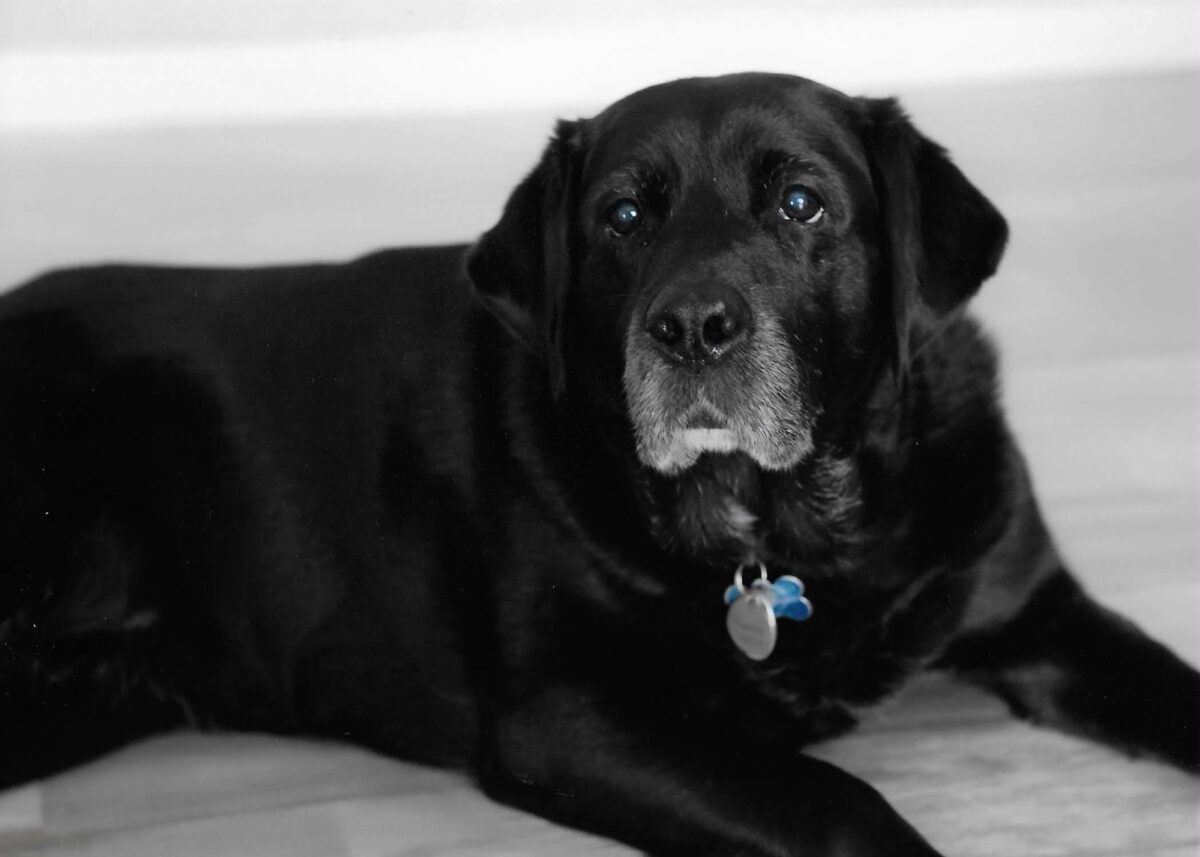
Image description: Tabby Marie, a retired black Labrador guide dog with a graying muzzle, rests quietly and looks straight at the camera.
Introduction: Documentation has to become accountability
Parts 1 and 2 of this series named rideshare discrimination against blind service dog handlers as ableism and traced its public health impacts. This final part asks what must change. If rideshare ableism causes psychological stress, social isolation, economic harm, trauma-related responses, and loss of autonomy, then the response cannot be limited to individual riders filing complaints after they have already been stranded.
This article also stands alone. Tabby was my service dog, and repeated rideshare denials shaped my decision not to get another guide dog after she died. I include that here not because my experience is the only story, but because it illustrates what the data also shows: discrimination can reshape mobility, confidence, health, and life decisions.
As a blind public health professional, I view this as a public health, civil rights, and consent issue. The surveys are clear. Guide Dogs for the Blind reported that ‘more than 83 percent’ of respondents had been denied access in rideshare contexts (Guide Dogs for the Blind, 2024). The Seeing Eye reported that ‘approximately 80%’ of respondents who used rideshare had experienced denial because of guide dogs (The Seeing Eye, 2024). These findings should move rideshare companies, regulators, public health professionals, and disability advocates from awareness to accountability.
The central principle is simple: blind service dog handlers should not have to prove, negotiate, or defend their right to travel every time they request a ride.
The legal baseline is not optional
The legal baseline is already clear. ADA.gov explains that service animals are dogs trained to perform tasks directly related to a person’s disability and that they are not required to wear a vest, tag, or special identification (U.S. Department of Justice, 2024). ADA guidance also states that staff may not require documentation, ask the dog to demonstrate its task, or ask about the nature of the person’s disability (U.S. Department of Justice, 2020).
Rideshare companies also state that service animal access is required. Uber’s U.S. policy says drivers may not deny service because of a service animal and that there are no exceptions for allergies, religious objections, or generalized fear (Uber, 2025). Lyft’s U.S. driver policy says drivers should ‘Always Say Yes’ to riders with service animals and states that drivers are required to accommodate service animals even when they have allergies, religious or cultural objections, or fear (Lyft, 2026).
These policies matter, but they are not enough. A policy that is repeatedly violated in practice is not yet a functioning access system. If the rider is still stranded, still charged, still asked for proof, still forced to explain the law, and still required to file reports after harm, then the system remains ableist even if the policy language is correct.
Consent must become part of compliance
Compliance should not be reduced to whether the rider eventually gets into a vehicle. The process matters. A ride that includes intimidation, illegal questioning, pressure to separate from a service dog, unwanted touch, or repeated complaint is not full access. It is access under duress.
A consent-based standard would ask different questions. Did the driver speak directly to the rider? Did the driver avoid touching the rider, cane, belongings, or dog without permission? Did the app protect the rider from preemptive cancellation after service animal disclosure? Did the complaint system preserve the rider’s autonomy instead of forcing them to relive the incident repeatedly?
For blind service dog handlers, access and consent cannot be separated. Transportation reform must protect both the right to enter the vehicle and the right to control one’s body, guide dog, mobility tools, communication, and personal space during the interaction.
Stronger enforcement and public accountability
Legal enforcement has already shown why stronger accountability is needed. In September 2025, the U.S. Department of Justice sued Uber under Title III of the ADA, alleging discrimination against passengers with disabilities, including blind individuals who use service animals and riders who use stowable wheelchairs (U.S. Department of Justice, 2025). The DOJ alleged that Uber and its drivers routinely refused service, imposed improper cleaning and cancellation fees, and failed to reasonably modify policies to avoid discrimination. The DOJ case page later noted that on March 5, 2026, the court denied Uber’s motion to dismiss (U.S. Department of Justice, 2026).
The Minnesota Department of Human Rights also announced a 2026 settlement with Lyft after an investigation found that drivers repeatedly canceled rides for Tori Andres, a blind student traveling with her service dog Alfred. The department stated that access to rideshare is ‘not a convenience, it is a civil right’ and announced settlement terms involving policy, education, app updates, complaint follow-up, and three years of monitoring (Minnesota Department of Human Rights, 2026).
These cases show that accountability cannot depend only on individual riders knowing the law. Enforcement must include audits, complaint tracking, financial consequences, public reporting, and monitoring by regulators. Companies should not be allowed to define success by written policies while riders continue to experience high rates of denial.
Economic repair should be built into policy
Economic repair should be built into policy. Guide Dogs for the Blind reported that ‘approximately 16 percent’ of respondents cited economic impacts from rideshare denials (Guide Dogs for the Blind, 2024). Those costs include alternative transportation, missed appointments, missed work, delays, and fees. The public health impact of discrimination is worsened when the harmed person also pays for the harm.
Rideshare companies should provide automatic fee reversal for verified service animal denials, reimbursement for reasonable alternative transportation, and meaningful compensation when riders miss appointments, interviews, work, flights, or essential obligations because of discrimination. Regulators should require companies to preserve evidence and share complaint data with enforcement agencies.
Economic protections should also address drivers. Drivers should not be financially incentivized to avoid disabled riders. If a ride requires additional communication, time to identify the vehicle, or safe boarding with a service dog, the platform should not penalize that time. A public health solution must recognize that driver labor conditions and rider access needs intersect, while still making clear that discrimination is never acceptable.
Driver education must move beyond compliance scripts
Driver education cannot be a one-time checkbox. It must be recurring, accessible, culturally responsive, and specific. Drivers need to know that service dogs are not pets, riders do not have to request a pet ride, riders do not have to show documentation in the United States, allergies and fear do not justify denial, and guide dogs should not be touched, fed, distracted, separated from the handler, or placed in the trunk.
Training should also teach respectful communication. Drivers should speak directly to the blind rider, identify themselves, confirm the rider’s name, give useful vehicle location information, and ask before offering assistance. They should not grab a rider, move a cane, handle belongings, touch the dog, or make decisions for the rider.
This is where the Ask First framework becomes useful. Ask First is a consent-based service model: ask before touching, guiding, moving belongings, handling a cane, interacting with a guide dog, changing someone’s physical environment, or using tactile communication. In rideshare, Ask First could become a simple training standard: announce who you are, describe where the car is, ask what works best, and follow the rider’s lead.
Examples of respectful driver scripts include: ‘Hi, this is your driver. I am parked at the curb on your right.’ ‘Would verbal directions help?’ ‘Would you like me to stay where I am and call out?’ ‘Please let me know the best way to support pickup.’ These scripts are not complicated. They recognize the rider as the authority on their own access needs.
Microaggression prevention belongs in driver training
Training should name microaggressions directly. Drivers should understand that asking for proof, questioning whether someone is blind, expressing surprise that a blind person is traveling independently, speaking to a companion instead of the rider, or complaining about the dog throughout the trip are not harmless comments. They are forms of ableist communication.
A stronger training model would identify common categories: denial of identity, denial of privacy, helplessness, patronization, minimization, second-class citizenship, and otherization (Keller & Galgay, 2010; Deroche et al., 2024). Naming these patterns helps drivers understand not only what they should avoid, but why the behavior causes harm.
Technology should support autonomy without forcing disclosure
App design should increase access without forcing disabled riders to disclose more than they want to disclose. Optional service animal disclosure can be helpful if it prevents denials and triggers driver reminders. But it can also create risk if drivers use disclosure to cancel before arrival. Any disclosure feature must be voluntary, privacy-protective, and paired with strong anti-cancellation enforcement.
Apps should include accessible pickup tools for blind riders, such as clear audio or text-based location descriptions, options to message drivers with saved access preferences, and simple ways to request that a driver announce themselves. Apps should make it easy to preserve cancellation evidence and report denial without navigating multiple inaccessible menus.
Technology should not be used to shift responsibility onto disabled riders. A feature that says ‘tell your driver you have a service animal’ is not enough if the platform does not hold drivers accountable for refusing the ride. The responsibility for nondiscrimination belongs to the company and driver, not to the rider’s ability to preemptively manage bias.
Public health research and community-led data
Public health agencies and researchers should treat rideshare ableism as a health equity issue. Transportation access affects healthcare, employment, social connection, safety, independence, and autonomy. Healthy People 2030 identifies transportation as part of the environments that shape health and quality of life (Office of Disease Prevention and Health Promotion, 2024). CDC identifies transportation barriers as a disability inclusion barrier (Centers for Disease Control and Prevention, 2025).
Future research should ask how rideshare discrimination affects stress, trauma-related symptoms, social isolation, economic stability, medical access, employment, relationship formation, parenting, caregiving, and guide dog partnership decisions. Surveys should explicitly include terms such as ableism, microaggressions, consent violations, autonomy, and embodied stress. If research only counts denials, it will miss the full harm.
Community-based participatory research is especially important. Blind service dog handlers should help design the questions, interpret the data, and decide what solutions are acceptable. Public health research that studies disabled people without centering disabled knowledge risks reproducing the same ableism it seeks to measure.
Culture change: from tolerance to equal belonging
Legal enforcement and app design matter, but culture change is also necessary. Many denials happen because drivers and members of the public still treat service dogs as negotiable. They treat blind people as exceptions. They frame access as a personal inconvenience instead of a shared civil rights obligation.
Public education campaigns should be clear: service dogs are working animals, not pets. Blind riders do not need to prove their disability to drivers. Allergies, fear, and discomfort do not justify denial. Complaining throughout a ride is not harmless. Asking illegal questions is not harmless. Driving away without communication is not harmless. These are forms of ableism with real health consequences.
Culture change also requires positive models. Drivers who provide respectful, accessible service should be recognized and used as examples in training. Many drivers already do the right thing. The Seeing Eye reported that more than 90 percent of respondents also had courteous driver experiences (The Seeing Eye, 2024). That matters. It shows that the goal is not impossible. The problem is not that rideshare can never work. The problem is that equal access should not depend on luck.
Conclusion: Equal access must be built, enforced, and measured
Rideshare ableism is not only a matter of individual driver behavior. It is a system-level problem that requires system-level reform. Companies must prevent denials, enforce policies, compensate harms, publish data, train drivers, design accessible reporting, and collaborate with blind service dog handlers. Regulators must monitor compliance and treat repeated service denials as civil rights and public health failures.
The core demand is simple: blind service dog handlers should be able to request a ride, enter the vehicle, travel safely, and arrive without being forced to prove their legitimacy. That is not special treatment. It is equal access. It is also a consent standard because the rider should remain in control of their body, guide dog, mobility tools, and communication throughout the trip.
This series began with the claim that surveys are documenting something larger than transportation inconvenience. They are documenting ableism. If health equity matters, then rideshare access matters. If autonomy matters, then consent in transportation matters. If public health matters, then disabled people’s ability to move through the world with dignity must be part of the conversation.
References
Centers for Disease Control and Prevention. (2025). Disability barriers to inclusion. https://www.cdc.gov/disability-inclusion/barriers/index.html
Deroche, M. D., Ong, L. Z., & Cook, J. M. (2024). Ableist microaggressions, disability characteristics, and nondominant identities. The Professional Counselor, 13(4), 404-417. https://doi.org/10.15241/mdd.13.4.404
Guide Dogs for the Blind. (2024). Rideshare Survey Report. https://www.guidedogs.com/uploads/files/Landing-Pages/GDB-Rideshare-Survey-Report.pdf
Keller, R. M., & Galgay, C. E. (2010). Microaggressive experiences of people with disabilities. In D. W. Sue (Ed.), Microaggressions and marginality: Manifestation, dynamics, and impact (pp. 241-267). Wiley.
Lyft. (2026). Service animal policy for US drivers. https://help.lyft.com/hc/en-us/articles/115013080048-Service-animal-policy
Minnesota Department of Human Rights. (2026). Rideshare companies cannot discriminate against Minnesotans with disabilities. https://mn.gov/mdhr/news-community/newsroom/?id=1061-730622
Office of Disease Prevention and Health Promotion. (2024). Social determinants of health. Healthy People 2030. https://odphp.health.gov/healthypeople/priority-areas/social-determinants-health
The Seeing Eye. (2024). Public Access Barriers for Guide Dog Teams: Survey Report. https://seeingeye.org/wp-content/uploads/2024/07/access-survey-report-1.pdf
Uber. (2025). Service Animal and Assistive Device Policy (United States). https://www.uber.com/us/en/about/accessibility/service-animal-policy/
U.S. Department of Justice. (2020). Frequently asked questions about service animals and the ADA. ADA.gov. https://www.ada.gov/resources/service-animals-faqs/
U.S. Department of Justice. (2024). Service animals. ADA.gov. https://www.ada.gov/topics/service-animals/
U.S. Department of Justice. (2025). Justice Department sues Uber for denying rides to passengers with service dogs, wheelchairs. https://www.justice.gov/opa/pr/justice-department-sues-uber-denying-rides-passengers-service-dogs-wheelchairs
U.S. Department of Justice. (2026). United States v. Uber Technologies, Inc. https://www.justice.gov/crt/case/united-states-v-uber-technologies-inc-0
Author Note
This series was written by Laura Millar and draws on original writing, research, and lived experience developed over time. Portions of this work were compiled and edited with the support of AI tools to help organize and synthesize existing drafts and materials. The perspectives, analysis, and conclusions presented here are the author’s own.
One reply on “From Rideshare Ableism to Accountability: Consent, Enforcement, and Public Health Reform”
[…] Part 3: From Rideshare Ableism to Accountability: Consent, Enforcement, and Public Health Reform […]