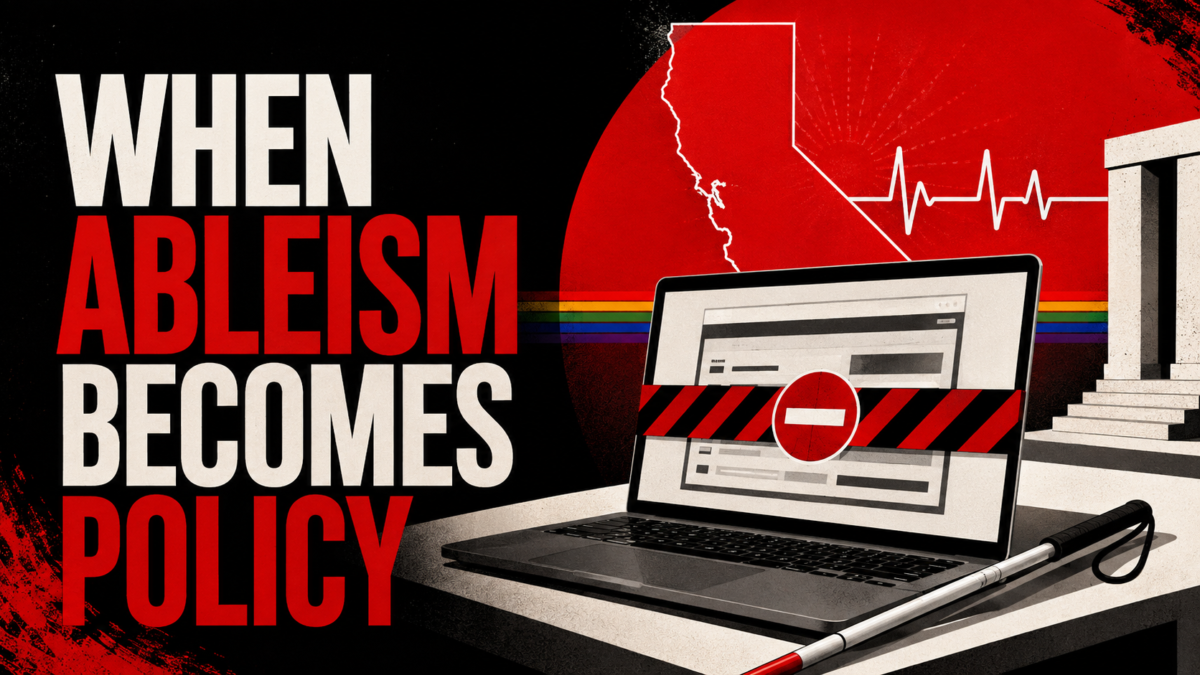
Image description: Editorial illustration reading “When Ableism Becomes Policy.” A blocked application appears on a laptop beside a white cane. California’s outline, a public health pulse line, government columns, and a narrow rainbow stripe appear in the background.
Authors note: I did not create the Hearing Request Letter Campaign. I am amplifying it because the problem it names is already inside my home and impacting my community. Join the Letter Campaign
Part One: The Problem
My Disabled child recently graduated from high school. He did what we tell young people to do. He stayed in school, completed his requirements, and reached the threshold of adulthood.
Graduation is supposed to mark a beginning. Work. Training. Independence. Purpose. A future of his own.
We submitted two applications to the California Department of Rehabilitation, the public agency created to help Blind, DeafBlind, and Disabled Californians prepare for employment and participate in the workforce.
We have received no response.
Not a plan. Not an explanation. Not even confirmation that someone sees him.
And there is a part of this story I need the Blind community, and everyone who cares about us, to sit with: neither application was accessible.
I am Blind. My child is not. When I sat down to complete his applications on a California government website, the forms did not work for me as a Blind parent. This is a state agency whose entire mission is serving Blind, DeafBlind, and Disabled people. State and federal law require government websites and online applications to be accessible. Consumers have filed complaint after complaint about these forms. The barriers remain.
Before a Blind applicant or a Blind parent can even reach the waiting list, they may need sighted assistance just to ask the state for help. The agency built to remove barriers to employment has placed a barrier at its own front door.
What is happening in California
California’s Order of Selection took effect on February 1, 2026. Order of Selection is what happens when a vocational rehabilitation agency says it cannot serve everyone who is eligible. It does not mean Blind, DeafBlind, and Disabled people have become less capable. It means the state is rationing access.
The federal Rehabilitation Services Administration currently reports that California has zero of its three priority categories open. Newly eligible applicants are being placed on waiting lists with no published reopening date.
According to California’s 2026 vocational rehabilitation plan, DOR projected $379 million in available resources against $498 million in costs. That is a $119 million gap.
People with signed Individualized Plans for Employment are legally supposed to keep receiving services. But a promise on paper only matters when people can actually obtain the equipment, training, authorizations, and qualified providers written into those plans.
California has also declined, at least for now, to use the federal exception that could provide one specific service or piece of equipment to someone who needs immediate help to keep an existing job. A Blind or Disabled Californian may already be employed, may know exactly what technology they need, and may still be required to wait until the job itself is gone.
And the closure is only part of the breakdown:
Orientation and mobility training, how Blind people learn to cross streets, board transit, and travel safely, is not reaching new applicants. That is a physical safety hazard, not a scheduling issue.
The community organizations that serve Blind, low vision, and DeafBlind Californians face chronic payment delays from DOR. With new referrals cut off, their service infrastructure faces permanent collapse.
DOR is shifting purchases away from experienced specialized vendors toward Amazon and low-cost general retailers. Assistive technology is not a product in a box. It requires expert assessment, setup, training, and ongoing support, an ecosystem that took years to build and will be extremely difficult to replace.
Reduced funding for the Older Individuals who are Blind program strips seniors of the daily living skills that keep them safely in their own homes, driving premature institutionalization.
And the breakdown begins before the waiting list: when applications are inaccessible, when they go unacknowledged, and when families receive no next step at all.
Why the timing is brutal
The months after high school graduation matter. School services end on a specific date. Adult systems do not automatically begin the next morning. Support during this transition connects a young person to training, work, relationships, and possibility. Delay turns momentum into isolation, anxiety, dependence, and lost opportunity.
A month spent waiting is not an empty month. Jobs close. Training programs begin without you. Skills go unused. Confidence erodes. Families reorganize their lives around a system they cannot make respond.
Ableism is not always loud. Sometimes it looks like an unanswered application. An inaccessible government form. A waiting list with no end date. A worker losing a job while waiting for the tool that would have saved it.
Ableism is a system designed as though Blind, DeafBlind, and Disabled people have unlimited time, unlimited family support, and unlimited capacity to absorb delay.
We do not.
Part Two: My Letter to Governor Newsom
This is the letter I sent. You are welcome to borrow from it when you write your own.
Subject: DOR Is Public Health Infrastructure. Please Support an Urgent Oversight Hearing.
Dear Governor Newsom,
I am a Blind Californian, a public health professional, and the parent of a Disabled young adult who recently graduated from high school.
My child has applied to the California Department of Rehabilitation twice. We have received no meaningful response. There is no accessible way to learn what is happening, no responsible person we can reach, and no explanation of what comes next. The applications themselves were not accessible, despite the law and despite years of consumer complaints. And as in so many families, the parent expected to become the unpaid case manager is also Blind, navigating state systems that were not designed for her to use.
I am writing to ask you for one thing. Please publicly support the request that Assembly Human Services Chair Alex Lee and Senate Human Services Chair Jesse Arreguín schedule an urgent joint legislative oversight interim hearing on the Department of Rehabilitation before irreversible harm occurs.
I make this request as a public health professional, because DOR is not a side program. It is public health infrastructure, and it is breaking in ways only a hearing can put on the record.
All three Order of Selection priority categories are closed. Every newly eligible applicant faces an indefinite waiting list with no published reopening date, including people who need a single service or piece of equipment to keep a job they already hold.
Orientation and mobility training is how Blind people learn to cross streets, board transit, and travel safely. Withholding it from new applicants is not a service delay. It is a direct physical safety hazard.
Clients with signed Individualized Plans for Employment, whose services are legally supposed to continue, are waiting months for the adaptive technology and training their plans were written to provide, stalling school and work.
The community organizations that serve Blind, low vision, and DeafBlind Californians face chronic payment delays, and with new referrals cut off, their service infrastructure faces permanent collapse. Purchases are shifting from experienced specialized vendors to Amazon and low-cost general retailers, but assistive technology is not a product in a box. It requires expert assessment, setup, training, and ongoing support. This ecosystem took years to build and will be extremely difficult to replace.
And reduced funding for the Older Individuals who are Blind program strips seniors of the daily living skills that keep them safely in their own homes, driving premature institutionalization that harms elders and costs the state far more than the training that prevents it.
Every one of these failures carries health consequences. Unemployment, poverty, chronic stress, isolation, and exclusion are among the most powerful drivers of physical and mental health. People lose confidence, routines, relationships, housing stability, and purpose. Anxiety and depression deepen. Caregivers exhaust. Families absorb strain the state was funded to prevent. And people pushed off the path to work are pushed onto public assistance, at greater cost to California.
Timely services also multiply. One piece of accessible technology connects a person to education, employment, telehealth, and other people. One course of travel training carries someone to work, medical appointments, and civic life. One referral to a blindness organization can become years of peer mentoring and mutual support. Community networks extend every public dollar DOR spends. When services are delayed, the state does not eliminate the need or save money. It shifts the cost onto Disabled people, families, community organizations, health systems, housing programs, and taxpayers.
Order of Selection is not simply a budget decision. It is a population health decision.
It is also how ableism becomes policy. Not as an openly discriminatory statement, but as an inaccessible application, an unanswered message, an indefinite waiting list, and a system that assumes Blind and Disabled people can absorb months of delay without lasting harm. We cannot.
I am not asking you to feel sorry for my child, for me, or for any Disabled Californian. Pity is not justice. A hearing is where the facts get on the record, responsibility gets named, and recovery begins.
When a Disabled young person crosses the graduation stage, California should meet them with a path forward, not silence. Please support this hearing.
Respectfully,
Laura Millar, MPH, MA
Blind Californian, parent, public health professional, and community organizer
Part Three: Why I Wrote It This Way
Why a public health letter and not a services complaint
I could have written a letter about my family’s case. I wrote a public health letter instead, because that is what this is.
Employment shapes nearly every condition that determines health: income, housing, food security, healthcare access, transportation, safety, relationships, and the ability to make choices about one’s own life. Vocational rehabilitation is upstream intervention. It is prevention. It is exactly the structural work our field claims to value.
If you work in public health, this is your conversation. Disability is the health equity issue our field keeps leaving off its own list. We publish about social determinants of health while a determinant this concrete, a functioning rehabilitation system, collapses in the largest state in the country with barely a professional murmur. We need public health professionals to name service delays as a health hazard, to bring data and cost analysis to the oversight process, and to stand with Disabled-led advocacy instead of speaking over it.
Why the letter asks for one thing
The campaign asks for one action: an urgent joint oversight interim hearing led by Assembly Human Services Chair Alex Lee and Senate Human Services Chair Jesse Arreguín. My letter matches that ask on purpose. A dozen competing demands are easy to ignore. One clear demand, repeated by thousands of Californians, is hard to ignore. The hearing is where the facts get on the record, responsibility gets named, and every other fix becomes possible.
Why I named the community networks
Budget arguments treat rehabilitation as a cost. I wanted the Governor to see it as a multiplier. One piece of technology, one course of travel training, one referral to a blindness organization ripples outward for years through peer mentoring, employment, and community leadership. Delay does not shrink that need. It just moves the bill to families, nonprofits, health systems, and taxpayers, and collects it later at a higher price.
Why the Blind community must not sit this one out
I serve on the board of the National Federation of the Blind of California and as Second Vice President of the NFB San Francisco Chapter, and I write here in my individual capacity.
My child is not Blind. I am still telling you this fight belongs to the Blind community.
Blind, DeafBlind, and low vision Californians depend on specialized services that generic systems do not replicate: Braille instruction, orientation and mobility, rehabilitation teaching, assistive technology assessment and training, and qualified providers who actually know blindness. When budgets collapse and categories close, specialized services are historically the first things quietly traded away. It is already happening: payment delays are starving our specialized providers, purchasing is drifting to general retailers, and the Older Individuals who are Blind program is being cut while our elders face premature institutionalization.
The inaccessible application is our issue. If a Blind parent cannot independently complete a DOR form today, a Blind applicant cannot either. We have filed the complaints. We know the law. We should not have to fight our own rehabilitation agency for the right to apply to it.
And we know how to do this. The Blind community has generations of experience organizing, testifying, and refusing to accept silence as an answer. Every Blind person navigates systems built by the same ableism that is now stranding Disabled graduates on waiting lists. When we show up for the whole Disabled community, we protect the services our own community cannot survive without. If we wait until the cuts reach Braille and cane travel to speak, we will be speaking too late.
Why this should matter across political differences
Anyone who values civil rights should oppose policies that exclude Blind, DeafBlind, and Disabled people. Anyone who values work and self-reliance should oppose a system that prevents people from working. Anyone who values families should recognize the harm of turning parents into unpaid case managers. Anyone who values responsible public spending should question the downstream cost of delaying services until preventable problems become crises.
I am not asking government to promise a life without barriers. I am asking it to answer an application, publish forms its own consumers can use, and make existing programs function.
What you can do
If you live in California, send a letter to your Assemblymember, State Senator, and Governor Newsom through the Hearing Request Letter Campaign. The campaign asks Assembly Human Services Chair Alex Lee and Senate Human Services Chair Jesse Arreguín to hold an urgent joint oversight hearing on DOR. Add your own experience if you can, and share it with others.
Let’s keep talking
If this post raised questions for you, whether you are a public health professional who wants to bring disability into your work, a family navigating DOR or transition services, or a Blind community member ready to organize, I would love to hear from you.
I consult, train, and coach on ableism, accessibility, disability justice, and public health, and I am always glad to talk with people who want to learn more or get involved.
Laura Millar, MPH, MA, MCHES, is a Blind public health professional, sociologist, sexuality educator, and DOR consumer. She serves on the board of the National Federation of the Blind of California and as Second Vice President of the NFB San Francisco Chapter, and writes here in her individual capacity.
Support this work
I hold master’s degrees in public health and human sexuality. Much of my work happens at the margins, alongside people whose bodies, experiences, and needs are too often overlooked.
That work draws on professional training, lived experience, and love for my communities. Much of it is grassroots and unpaid. Your support helps sustain the time and care I put into education, writing, advocacy, and community organizing.
If this work matters to you and you have the means, I welcome your support.
Contributions support my independent work and are not tax-deductible charitable donations.
2 replies on “When Ableism Becomes Policy: The Public Health Cost of Delayed Rehabilitation”
Sorry your poor baby isn’t getting services. What is his disability? Also, Order of Selection starts in California on August 31. It didn’t start in February. So he should be geting services by now.
There was a delay, but this isn’t about one person’s case. Please don’t go around asking people what their disability is. It’s rude.