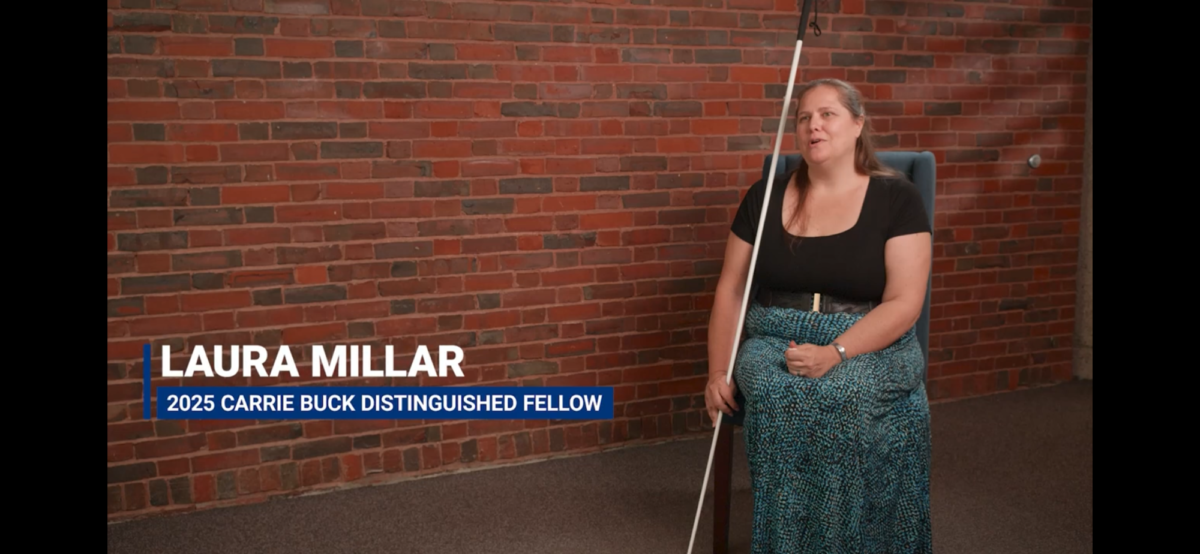
Image description: Laura Millar sits in front of a red brick wall during a filmed interview, holding a long white cane while speaking. She is wearing a black top and a blue patterned skirt. On-screen text identifies her as “Laura Millar” and “2025 Carrie Buck Distinguished Fellow.”
I was honored to have been selected as the 2025 Carrie Buck Distinguished Fellow by the Lurie Institute for Disability Policy at Brandeis University. This fellowship provided a powerful platform to explore the intersections of disability justice and reproductive justice, with a particular focus on autonomy, consent, and combating sexual ableism.
Understanding Carrie Buck’s Legacy
The fellowship honors the legacy of Carrie Buck, a woman with disabilities whose story represents one of the darkest chapters in American legal history. Following the 1927 Supreme Court decision in Buck v. Bell, Carrie Buck was forcibly sterilized, a decision that was justified through a eugenicist framework that has haunted disability communities ever since.
The Carrie Buck Distinguished Fellowship supports advocates working to address the ongoing impacts of eugenics, ableism, and systemic barriers faced by disabled people, particularly in areas where disability, autonomy, and humanity intersect most visibly: sexuality, relationships, parenting, and reproductive rights.
Watch the Fellowship Discussion
What does it mean to build a society where disabled people have full agency over their bodies, their sexuality, their reproductive choices, and their futures? In this powerful keynote discussion, I sat down with Rebecca Cokley, Program Officer at the Ford Foundation, Ayesha Elaine Lewis, Senior Staff Attorney at the Disability Rights Education and Defense Fund, and Maddie Crowley, Communications Specialist at the Lurie Institute for Disability Policy, to explore this essential question.
Together, we reflected on the haunting legacy of Carrie Buck, the persistence of sexual ableism in contemporary society, the critical importance of consent education for disabled people, and pathways toward greater autonomy and justice for disabled communities.View the Full Video →
What is Sexual Ableism?
Sexual ableism is the devaluing of disabled people, especially around reproductive health and sexuality. It manifests in many forms, some obvious and others insidious. It appears in state laws that permit parental disability to be grounds for termination of parental rights. It emerges when society refuses to see disabled people as sexual, when reproductive health choices are restricted, and when the right to parent is denied. It can be as straightforward as someone not wanting to date a disabled person or assuming a disabled person’s life is inherently inferior.
But perhaps the most damaging aspect of sexual ableism is when we internalize these messages ourselves. For nearly nine years after my diagnosis as a blind woman in my early twenties, I carried questions that felt deeply personal: Who will want to date me? Will I ever be a parent? These fears felt mine alone, until I found community and learned that thousands of other disabled people had carried the exact same questions. I realized then that the problem was not within me, it was systemic.
“When we give people the language of ableism, when we explain what it is on both sides for the disabled person to understand and for the non-disabled person to understand, then we can have a healthier, safer society.”
The Power of Language and Community
When I came to community and learned the language of ableism and sexual ableism, everything shifted. What had felt like personal failing revealed itself as societal barrier. More importantly, I discovered a roadmap for change. I learned that there are hundreds of thousands of blind parents out there. I found disabled people who were living full lives marked by relationships, pleasure, and autonomy. Finding this community was transformative.
This is precisely why education and consent matter so much for disabled people. We cannot advocate for our own autonomy if we lack the language to name what is being denied to us. We cannot build healthier relationships if no one has taught us about consent. We cannot reclaim our sexuality and reproductive rights if we have internalized the message that we do not deserve them.
Moving Forward
The work of disability justice and reproductive justice is deeply interconnected. Both demand that we recognize disabled people as full human beings, as people worthy of love, pleasure, sexuality, parenthood, and autonomy. Both require us to dismantle systems that have historically sought to control disabled bodies and limit disabled futures.
This fellowship was an opportunity to advance these conversations and to honor Carrie Buck’s memory not through mourning her loss, but through fighting for the rights and dignity that were stolen from her, rights that continue to be denied to many disabled people today.
I was grateful to the Lurie Institute for this opportunity and to everyone who continues to push for disability justice in their own communities and lives.
Celebrating the 2026 Fellow: Evan Sweeney
I want to take a moment to celebrate the 2026 Carrie Buck Distinguished Fellow, Evan Sweeney. Evan brings critical perspectives to this fellowship and continues the vital work of advancing conversations around pleasure, disability justice and reproductive autonomy. His keynote discussion explored important intersections within pleasure and disability advocacy, and I was moved by the depth and thoughtfulness he brought to these conversations.
Evan’s video will be shared soon, and I encourage you to watch it. His message and work are essential to this ongoing movement for disability justice and the fight to honor the legacy that Carrie Buck represented.
About Laura Millar
Laura Millar is a disability justice advocate, consultant, and speaker committed to advancing reproductive justice, sexuality education, and autonomy for disabled people. As the 2025 Carrie Buck Distinguished Fellow at Brandeis University’s Lurie Institute for Disability Policy, Laura leads conversations that center the experiences of disabled people at the intersections of disability justice, reproductive rights, and sexual autonomy.
A blind queer woman and leading voice in disability advocacy, Laura brings lived expertise and strategic insight to organizations, institutions, and communities seeking to build more inclusive, equitable, and disability-affirming practices. Her work has been featured across national platforms, and she has consulted with leading foundations, nonprofits, and educational institutions on disability inclusion and reproductive justice.
If your organization is exploring disability justice, reproductive justice, sexuality education, or building more accessible and inclusive practices, Laura is available for consulting, speaking engagements, workshops, and strategic partnerships.
Get in TouchBook a Speaking Event
Full Video Transcript
Provided for accessibility. This is the complete descriptive transcript of the fellowship discussion video.
[0:03]
Laura Millar, 2025 Carrie Buck Distinguished Fellow.
Laura Millar:
“When we give people the language of ableism, when we explain what it is on both sides for the disabled person to understand and for the non-disabled person to understand, then we can have a healthier, safer society.”
[0:20]
Carrie Buck Distinguished Fellowship, a black and white photo of Carrie Buck seated with her mother, Emma, alongside the Lurie Institute for Disability Policy logo.
Rebecca Cokley, Program Officer at the Ford Foundation:
“Carrie Buck was a woman with disabilities who became pregnant and was the subject of a Supreme Court case in Buck versus Bell. And the decision was that she should be involuntarily sterilized because, in the words of Justice Oliver Wendell Holmes, three generations of imbeciles are more than enough.”
Ayesha Elaine Lewis, Senior Staff Attorney at the Disability Rights Education and Defense Fund:
“It talked about the fear that too many undesirable people being born would sap the strength of society. These ideas are disgusting. They were inspirational to the Nazis in Germany and we should remember this part of our history and reckon with it fully.”
Maddie Crowley, Communications Specialist at the Lurie Institute for Disability Policy:
“So the Carrie Buck Fellowship is really an opportunity for the Lurie Institute and Brandeis as a university to reconcile with some of the harms of the Buck v. Bell court decision. It was actually such a wonderful opportunity for an individual to come and educate people about people with disabilities and how that intersects with reproductive care, access, reproductive justice and things like that.
When we’re searching for a new Carrie Buck fellow, we’re really looking for someone who brings a part of this conversation that hasn’t really been heard before. Someone that really cares about both disability justice and reproductive justice. Laura brings a really interesting approach to this. As a blind queer woman, she has come into this opportunity with the fellowship really bringing people to her level in a really accessible way to educate people about her experience and the experience of her community.”
Laura Millar:
“For about 9 years, I didn’t know that I had an entire community out there of disabled and blind people who had the same fears. Sexual ableism is the devaluing of disabled people, especially around reproductive health or sexuality.
Many states have laws where parental disability is grounds for termination of parental rights.
Seeing somebody as not sexual. It might be around reproductive health choices and removing the right to parent. It could just be not wanting to date a disabled person or thinking that a disabled person’s life might be less than or inferior. The most insidious parts of sexual ableism is when we internalize the messages around it. And so I know for myself as a blind woman in my early 20s when I was first diagnosed, I had those questions. Who will want to date me? Will I ever be a parent? Those questions were rooted in sexual ableism. And I just didn’t have role models. I didn’t know that there are hundreds and thousands of blind parents out there.
Rebecca Cokley:
“Laura’s work is so incredibly exciting to me, particularly the conversations around consent because people don’t talk to people with disabilities about consent.”
Laura Millar:
“But what I found when I came to community, when I learned the language of ableism, and when I certainly started to learn the language of sexual ableism, was that it wasn’t me. It was society. It was systemic. And it was something that then I had a road map to change.”
[8:46]
Perky, resilient, involved, determined, excited, blind, and blind proud.
(The video concludes with music and additional visuals of community, pride events, and family moments.)